

The hospital discharge papers say “home health PT and OT,” and nobody explained what that means. Which therapist does what? Does your parent need both? And will Medicare pay for it?
That moment of confusion is common for families in Orland Park, Palos Heights, and across the south suburbs. This guide explains what physical therapy (PT) and occupational therapy (OT) each do in the home, when a person needs both, and how Medicare treats each one. It comes from Choice Care Home Health, a Medicare-certified, ACHC-accredited home health agency that provides both therapies.
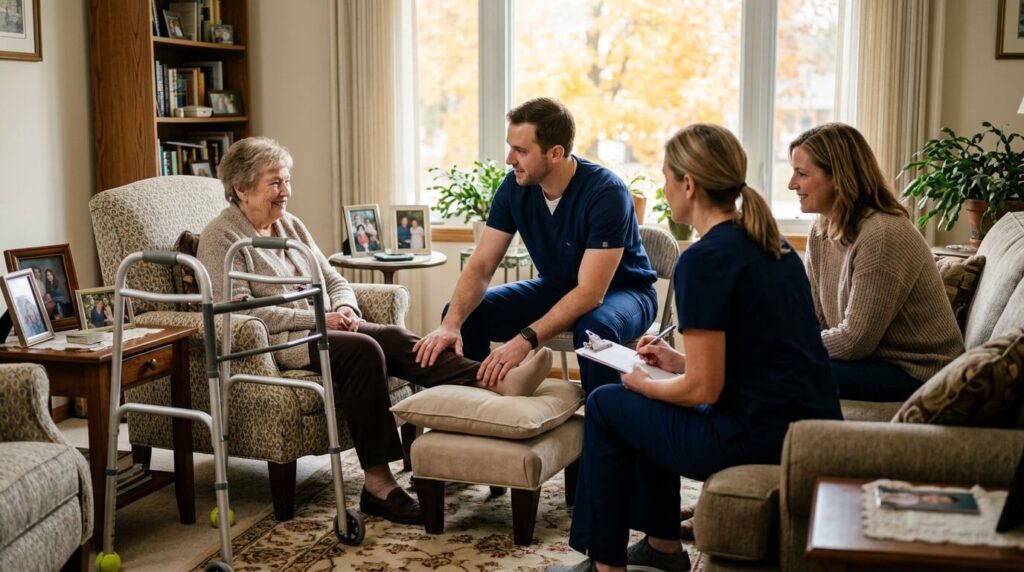
Physical Therapy vs Occupational Therapy at Home: The Short Answer
Physical therapy at home helps you move better: strength, balance, walking, and pain. Occupational therapy at home helps you manage daily life: bathing, dressing, cooking and making the home safer. Many home health patients get both, and Medicare can cover both under the home health benefit when a doctor orders them and the eligibility rules are met.
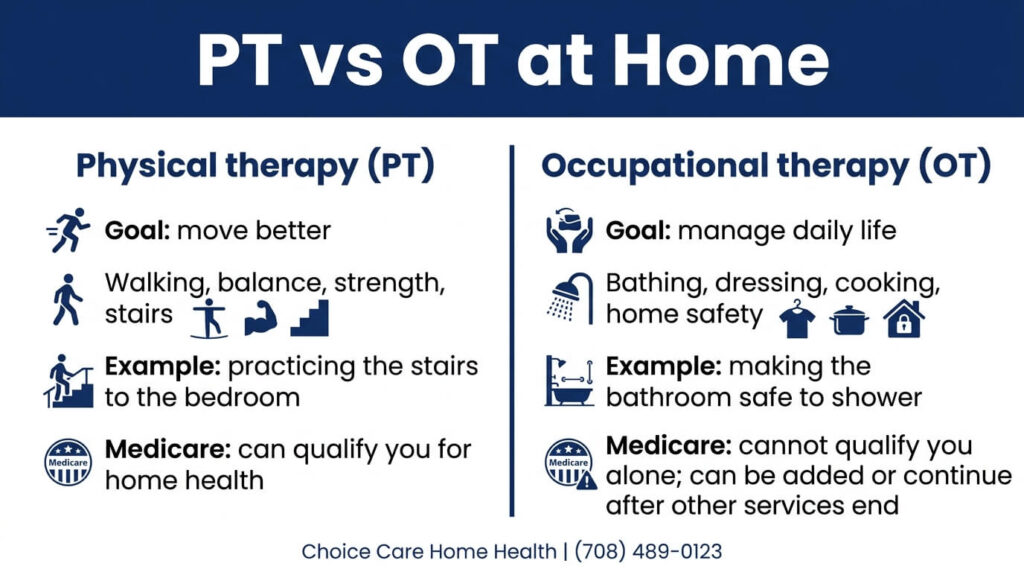
An easy way to remember it: PT gets the body moving again. OT gets the day working again.
| Physical therapy (PT) at home | Occupational therapy (OT) at home | |
| Main goal | Restore movement, strength, balance and walking | Restore the ability to do daily activities safely and independently |
| What the therapist works on | Walking, stairs, getting in and out of bed or a chair, balance, pain | Bathing, dressing, cooking, medication routines, adaptive equipment |
| Typical home example | Practicing the stairs to the bedroom | Setting up the bathroom so showering is safe |
| Common reasons | Joint replacement, falls, stroke, weakness after illness | Stroke, arthritis, memory or vision changes, recovery that affects self-care |
| Home safety role | Mobility and fall risk around the house | Home safety evaluation, equipment and layout changes |
| Medicare home health | Can qualify you for the benefit | Cannot qualify you alone; can be added to a plan or continue after other services end |
Not sure which one to ask for? Call our team at (708) 489-0123 and we will help you sort it out.
What Is Physical Therapy at Home?
A physical therapist evaluates how you move and builds a plan to rebuild strength, balance, flexibility and endurance. At home, that work happens in the rooms and on the stairs you actually use, not in a clinic gym. Learn more about our physical therapy services.
What a physical therapist works on at home
- Walking and gait, including safe use of a cane or walker
- Balance and fall prevention
- Strength and endurance
- Getting up from a bed, chair, or toilet (transfers)
- Stairs, steps and the front door threshold
- Pain management through guided exercise and positioning
- A home exercise program you can continue between visits
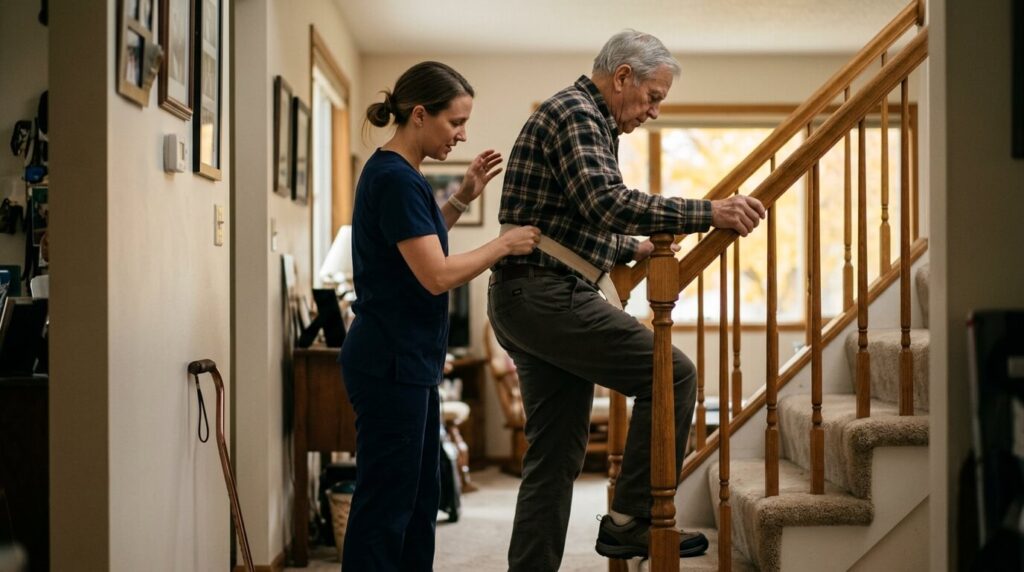
What a home PT visit looks like
The therapist watches you move through your own space: walking from the bedroom to the kitchen, going up the stairs, standing from your favorite chair. They then adjust the exercises to what you need to do at home, teach family members how to help without risking a fall, and report progress to your doctor. For more on why therapy matters for older adults, read our guide to the benefits of physical therapy for elderly patients.
What Is Occupational Therapy at Home?
In occupational therapy, “occupation” means the everyday activities that fill your day, not a job. An occupational therapist helps you do what you need and want to do safely, using practice, new techniques, equipment, and changes to your surroundings. See our occupational therapy services or read what occupational therapy services include.
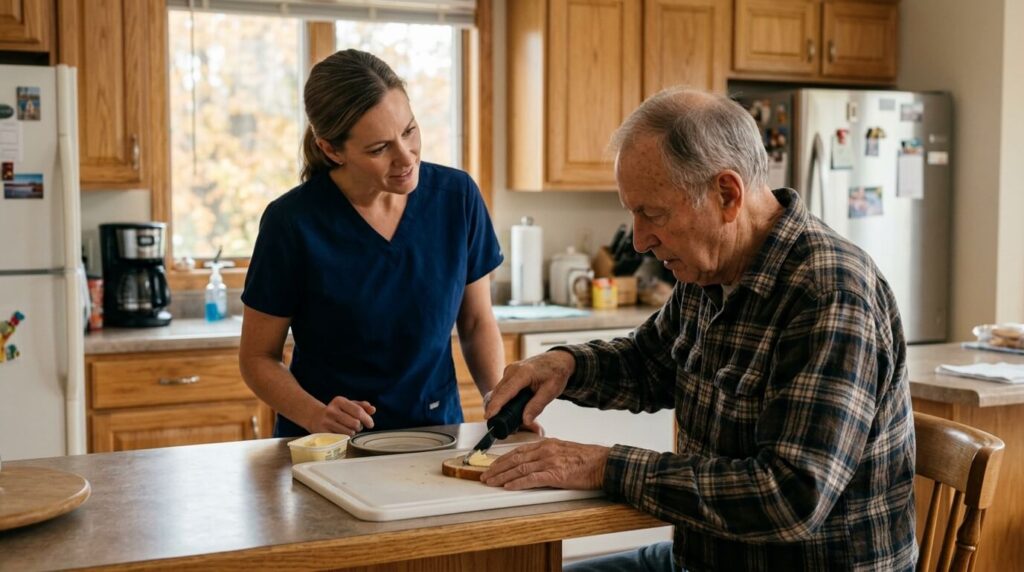
Daily living skills occupational therapy supports
- Bathing, showering and grooming
- Dressing
- Toileting and moving safely in the bathroom
- Cooking and meal preparation
- Managing medications and daily routines
- Using adaptive tools such as a reacher, shower seat or built-up utensils
- Memory and vision strategies
- Pacing activities when energy is limited
Home safety evaluation
An occupational therapist can review your home for hazards and suggest practical changes: loose rugs, poor lighting, a low toilet, a slippery tub, a cluttered path to the kitchen. Recommendations might include grab bars, a shower seat or a rearranged kitchen. Ask what is and is not covered before buying equipment. In Orland Park, see our page on occupational therapy in Orland Park.
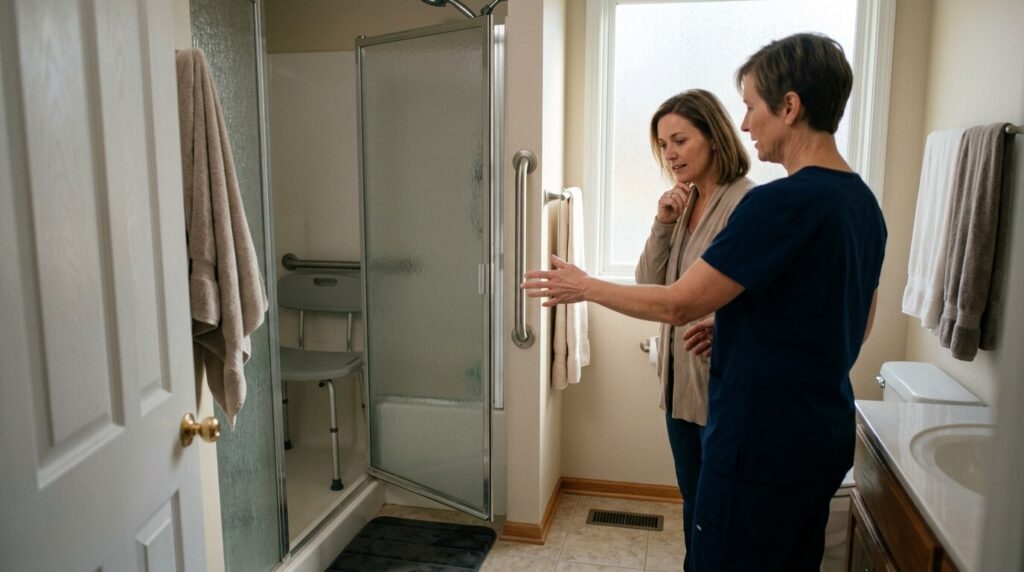
How Physical and Occupational Therapy Overlap
The two therapies are different, but they share a lot. Both are delivered by licensed professionals, both are ordered by a doctor, both set goals with you and your family, and both aim for safety and independence at home.
They also support each other. A physical therapist builds the leg strength and balance to stand at the sink. An occupational therapist shows you how to set up the kitchen so you can cook from that position safely. In home health, the therapists share information with each other and with the nurse, so the plan fits together.
Which Therapy Does Your Loved One Need?
Your doctor orders therapy, and the agency’s therapists evaluate and decide what is right. These examples show how the work is often divided. They are illustrations, not medical advice.
After a stroke
PT focuses on walking, balance and strength, especially on the weaker side. OT focuses on dressing, eating, bathing and relearning daily tasks. A speech-language pathologist may also help with communication or swallowing. Read more about home health care after a stroke.
After a hip or knee replacement
PT focuses on range of motion, strength, walking and stairs. OT focuses on dressing, bathing and using the toilet while following movement precautions, and on equipment that makes those tasks easier. See our guide to hip and knee replacement recovery at home.
After falls or with a high fall risk
PT works on balance, gait and leg strength. OT looks for hazards in the home and adjusts routines so the person is less likely to fall. Our fall safety tips for seniors cover simple steps families can take now.
With Parkinson’s disease
PT focuses on walking, posture, flexibility and balance. OT focuses on keeping daily routines manageable, such as eating, dressing and moving around the kitchen and bathroom. Learn about home health care for Parkinson’s patients.
After a hospital stay
Illness and bed rest often leave older adults weak. PT helps rebuild strength and mobility. OT helps restore the self-care routines that make living at home possible. Our guide to care after hospital discharge explains what to expect.
Can You Have Both at the Same Time?
Yes. Many home health patients receive PT and OT within one plan of care. The doctor orders the therapies, the agency schedules each therapist, and they share their findings so the goals do not conflict. How often each therapist visits depends on the doctor’s orders and the therapist’s evaluation.
Does Medicare Cover PT and OT at Home?
Original Medicare can cover both under the home health benefit when certain conditions are met. According to Medicare’s guide Medicare and Home Health Care, you must:
- Be under the care of a doctor or other allowed provider, with services in a plan of care that they establish and review regularly
- Need skilled care, which your provider certifies: intermittent skilled nursing, physical therapy, speech-language pathology, or continued occupational therapy
- Be homebound, meaning leaving home takes a major effort
- Have had a face-to-face encounter with your provider related to why you need care
- Receive care from a Medicare-certified home health agency

The occupational therapy rule most families miss
Medicare does not let occupational therapy alone open the home health benefit. If OT is the only skilled service you need, you generally cannot start home health under Medicare. But if you qualify because you need skilled nursing, physical therapy or speech-language pathology, OT can be included in your plan. When those other services end, you can continue Medicare-covered OT under the home health benefit if you still need it. Medicare Interactive explains this rule in detail. Coverage rules can change, so confirm the current rules with Medicare or with us.
Medicare Advantage plans
If you have a Medicare Advantage plan, home health is still part of your benefits, but the plan may have its own network and approval requirements. See our pages on Medicare coverage for home health in Illinois, who qualifies and insurance plans we work with. Call us and we will check your plan.
How Home Health Therapy Starts
- Talk to the doctor or discharge planner. Ask for a home health referral that includes PT, OT or both.
- Choose a Medicare-certified agency. You can ask for the agency you prefer, even if you are given a list.
- Intake and coverage check. The agency confirms your insurance and gathers your history.
- Start-of-care visit. A clinician evaluates your health, how you move and how you manage daily tasks, and looks at your home for hazards.
- Plan of care. The therapist sets goals with you and your doctor and schedules visits.
- Ongoing progress reviews. Your care team updates your doctor until the goals are met.
Nursing and aide care may be part of the same plan. If you are comparing those, read our post on skilled nursing vs home health aide.
PT and OT at Home in Orland Park, Palos Heights and Will County
Choice Care Home Health is a Medicare-certified, ACHC-accredited home health agency based at 15635 S 94th Ave in Orland Park, IL. We have served patients since 2001 and provide physical therapy, occupational therapy, speech-language pathology, skilled nursing, medical social work and home health aides in Orland Park, Palos Heights, Oak Lawn and Will County.
Because one agency provides nursing and therapy, your care team can plan visits together instead of leaving the family to coordinate between providers.
Frequently Asked Questions About Physical and Occupational Therapy at Home
What is the main difference between physical therapy and occupational therapy at home?
Physical therapy focuses on movement: strength, balance, walking, stairs and pain. Occupational therapy focuses on daily activities: bathing, dressing, cooking, managing medications and making the home safer. In home health, the two often work together, and both are ordered by a doctor and delivered by licensed therapists.
Can you have physical therapy and occupational therapy at the same time?
Yes. Many home health patients receive both within one plan of care. The doctor orders the therapies, the agency schedules each therapist, and the two share their findings so the goals fit together. How often each therapist visits depends on the doctor’s orders and the therapist’s evaluation.
Does Medicare cover physical therapy at home?
Original Medicare can cover physical therapy at home under the home health benefit when you are under a doctor’s care, need skilled therapy, are homebound, have had a face-to-face visit with your provider, and receive care from a Medicare-certified agency. Medicare Advantage plans may add network and approval rules, so check your plan.
Does Medicare cover occupational therapy at home?
Yes, with one important rule. Occupational therapy alone cannot qualify you for Medicare home health. If you qualify because you need skilled nursing, physical therapy or speech-language pathology, occupational therapy can be added. It can also continue after those services end if you still need it.
Do I need to be homebound to get in-home therapy?
For Medicare home health, yes. Medicare describes homebound as leaving home requiring a major effort, often with help from a person or device. Short, occasional trips such as medical appointments do not automatically rule you out. If you are unsure, call us and we will walk through your situation.
Do I need a doctor’s order for home physical therapy?
For Medicare home health, yes. Your doctor or another allowed provider must certify that you need skilled care and set up a plan of care that they review regularly. If you are leaving a hospital, ask the discharge planner to include physical therapy, occupational therapy or both in the home health referral.
Which therapy helps with falls and balance, PT or OT?
Both help. A physical therapist works on balance, strength and walking. An occupational therapist looks at the home itself, including rugs, lighting, bathroom setup and daily routines, and recommends changes and equipment. For fall risk, many people benefit from both.
Is occupational therapy only for hands and arms?
No. Occupational therapy covers any activity a person needs or wants to do, including bathing, dressing, cooking, managing medications and moving safely around the home. Hand and arm function is one part of it, but occupational therapists also address memory, vision, energy and home safety.
What happens at the first home health therapy visit?
A clinician reviews your medical history and doctor’s orders, watches how you move and manage daily tasks, and looks at your home for hazards. Together you set goals, and the therapist builds a plan of care with the doctor. Expect questions about what matters most to you at home.
How do I get in-home therapy in Orland Park, IL?
Ask your doctor or hospital discharge planner for a home health referral that includes physical therapy, occupational therapy or both, and tell them you would like Choice Care Home Health. You can also call (708) 489-0123 and our team will explain the steps and check your coverage.
Choosing the Right Home Therapy
If the goal is to move better, walk safely or regain strength, think physical therapy. If the goal is to bathe, dress, cook or manage the day with less struggle, think occupational therapy. If both apply, ask for both. Your doctor and therapists will decide the right mix after an evaluation.
Not sure whether to ask for PT, OT, or both? Contact Choice Care Home Health or call (708) 489-0123. We will explain your options, check your Medicare or Medicare Advantage coverage, and help you take the next step.
This article is general information, not medical advice. Your doctor and therapist determine the care you need.