
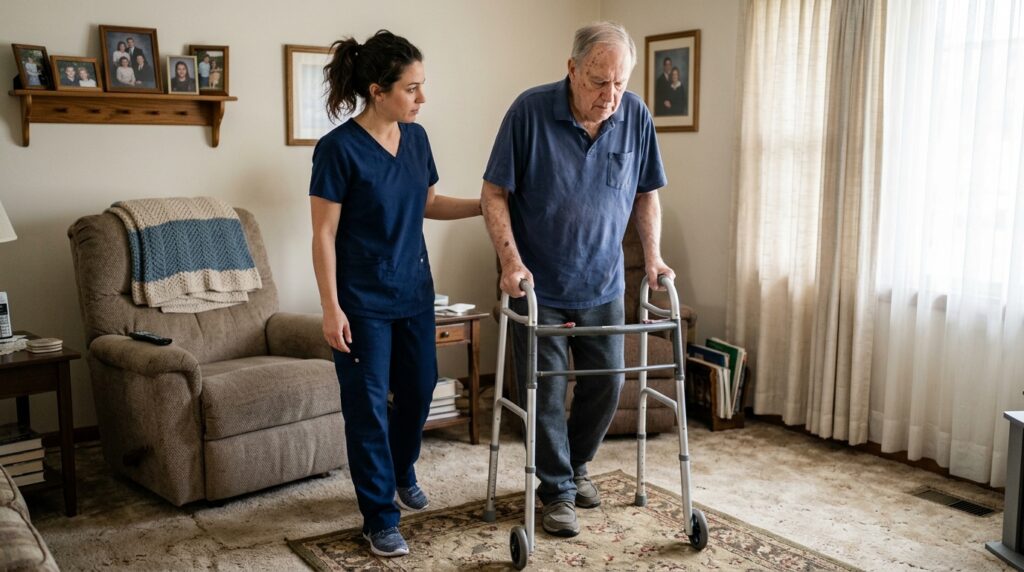
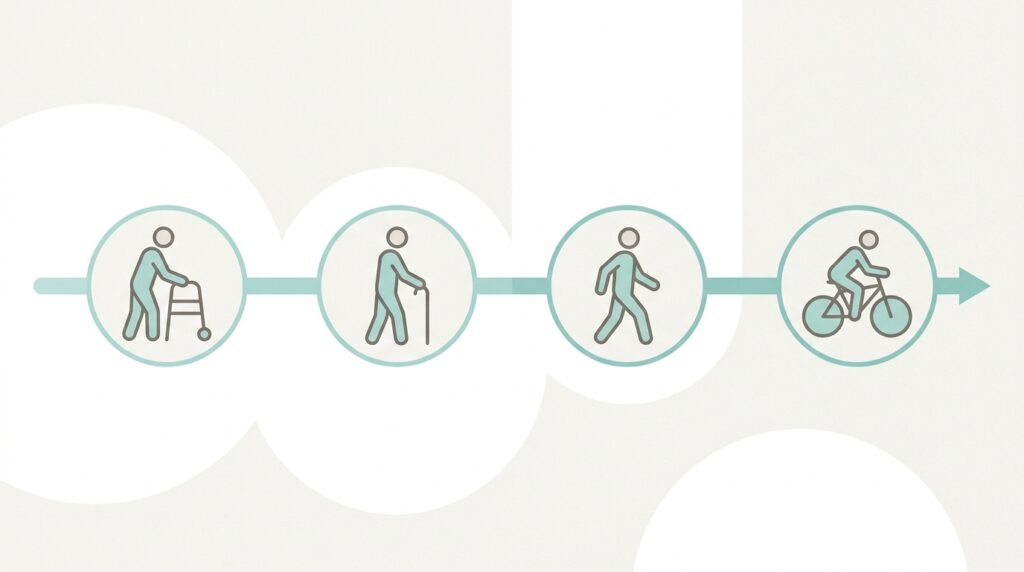
Hip and knee replacement recovery at home follows a predictable set of milestones: a walker for the first one to two weeks, a cane by weeks three to four, most daily activities by week six, low-impact activity by month three, and full strength within a year. The table below is the whole recovery at a glance. Print it, put it on the fridge, and check off each row. Everything after it explains what each milestone looks like for seniors recovering across Chicago’s southwest suburbs, and when to ask for help.
| Milestone | Knee Replacement | Hip Replacement |
| First steps | Day of surgery, with help | Day of surgery, with help |
| Walker | Weeks 1–2 | Weeks 1–3 |
| Cane | Weeks 3–4 | Weeks 3–6 |
| Shower standing | Week 2–3 (if wound sealed) | Week 2–3 |
| Driving | Weeks 4–6 (off opioids, right leg later) | Weeks 4–6 |
| Most daily activities | Week 6 | Week 6 |
| Low-impact exercise | Months 3+ | Months 3+ |
| Full strength | Up to 12 months | 3–6 months |
These are typical patterns, not promises. Your surgeon’s protocol always wins.
How Long Does Hip and Knee Replacement Recovery Take at Home?
Plan on six weeks to feel capable, three months to feel mostly yourself, and up to a year for full strength. That range is normal: the American Academy of Orthopaedic Surgeons notes that more than one million of these procedures are done annually in the US, and recovery speed varies with age, weight, pre-surgery strength, and how consistently you do your exercises. What follows breaks the table down row by row.
Knee Replacement Recovery Week by Week
Weeks 1–2: The Hard Part
The first two weeks are the toughest, and knowing that helps. Expect real pain, significant swelling, and fatigue that surprises you. Your jobs: walk short distances every hour or two with the walker, ice and elevate several times a day, take pain medication on schedule rather than toughing it out, and do your bending exercises even when you’d rather not. Most protocols aim for roughly a 90-degree knee bend by the end of week two, because the scar tissue forming now determines your flexibility later.
This is also when home physical therapy usually starts, often within a day or two of discharge. A therapist who has seen a thousand week-one knees can tell you in thirty seconds whether yours is on track, which is worth more than any 3 a.m. search.
Weeks 3–6: Turning the Corner
Somewhere in week three or four, most people trade the walker for a cane and notice the first genuinely good day. Walks stretch to ten and then twenty minutes. Knee bend pushes toward 110–120 degrees. Many patients drive again in this window, once they’re off opioid pain medication and can slam a brake pedal without hesitation; right-knee patients wait longer than left.
Two traps to avoid here: doing too much on the first good day, and quietly skipping exercises because you “feel fine.” Both show up as setbacks in week five.
Weeks 7–12 and Beyond
By three months, most knees handle errands, stairs, gardening, golf, cycling, and swimming. Stiffness after long sitting and warmth around the joint can linger for months and are normal. Strength and comfort keep improving to the one-year mark, especially if you continue the at-home exercises that build senior mobility after formal therapy ends.
Hip Replacement Recovery: Milestones and Precautions
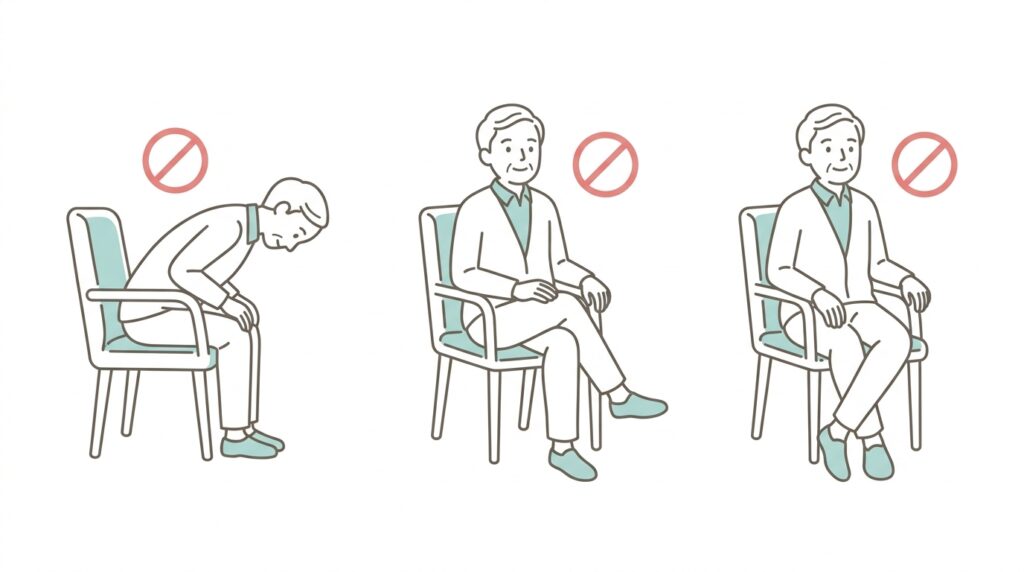
Hip recovery follows a similar arc with one big addition: hip precautions. These are movement limits that protect the new joint while the tissue around it heals, typically for 6–12 weeks. With the common posterior approach, that usually means:
- Don’t bend the hip past 90 degrees (no low chairs, no leaning down to tie shoes)
- Don’t cross your legs
- Don’t twist the operated leg inward
Patients with an anterior approach (from the front of the hip) often have fewer restrictions, which is why your surgeon’s instructions override any list you read online, including this one. An occupational therapist earns their keep here, teaching you to dress, bathe, and pick things up without breaking precautions; that’s exactly what in-home occupational therapy covers.
Otherwise, expect the walker for one to three weeks, a cane into weeks four to six, driving around weeks four to six, and most daily activities by week six. Full hip recovery typically lands at three to six months, often faster than knees.
Recovering in Palos Heights, Orland Park, or anywhere in the southwest suburbs? Choice Care Home Health sends licensed physical and occupational therapists to your living room, usually starting within 24–48 hours of your discharge referral. Call (708) 489-0123 to set up home therapy before surgery day.
How to Prepare Your Home Before Joint Replacement Surgery
- Clear the walking paths. Remove throw rugs and cords along every route you’ll take with a walker; it needs more width than you think.
- Set up a recovery station. One firm chair with armrests, at the right height, with phone, charger, water, medications, and ice packs within reach.
- Raise what’s too low. A raised toilet seat and a shower chair matter for both joints, and they’re essential for hip precautions.
- Move essentials to counter height. Kitchen items you’ll use daily should sit between waist and shoulder level before you leave for the hospital.
- Plan the first two weeks of meals and rides. Cook and freeze ahead, and line up drivers for follow-up appointments before you can drive.
- Arrange help for personal care. If bathing or dressing help is likely, a home health aide can be part of your Medicare-covered plan of care.
Warning Signs You Should Never Wait On
Normal recovery includes swelling, bruising, stiffness, and tiredness. These are different; call your surgeon or nurse the same day:
- New calf pain, swelling, or warmth in either leg, possible signs of a blood clot (DVT)
- Sudden shortness of breath or chest pain, call 911, possible pulmonary embolism
- Fever over 101°F (38.3°C), or chills
- Increasing redness, drainage, or opening at the incision
- Pain that gets worse instead of better despite medication
A home health nurse checks for exactly these at every visit, which is one reason skilled nursing after surgery reduces the odds a small problem becomes a readmission. General information on joint replacement recovery is also available at MedlinePlus, the National Library of Medicine’s patient site.
How Home Health Care Speeds Joint Replacement Recovery
Most seniors in Cook, DuPage, and Will counties qualify for Medicare-covered home health after a hip or knee replacement: a doctor orders it, you’re temporarily homebound, and a Medicare-certified agency delivers it, typically at no out-of-pocket cost for the visits. A typical joint replacement plan combines home physical therapy to rebuild strength and range of motion, occupational therapy for safe daily activities, and nursing for incision checks and medication management. Why that first stretch of therapy matters so much is covered in our post on physical therapy after surgery for seniors, and the wider discharge picture in our guide to care after hospital discharge.
For orthopedic discharge planners and case managers: Choice Care Home Health accepts same-day joint replacement referrals across Chicago and the southwest suburbs, with PT evaluation typically within 48 hours. Fax orders to (708) 489-2399 or call (708) 489-0123.
Key Takeaways
- More than one million hip and knee replacements are performed in the US each year, according to the American Academy of Orthopaedic Surgeons (AAOS), and most recovery happens at home, not in the hospital.
- Typical arc: walker for 1–2 weeks, cane by weeks 3–4, most daily activities by week 6, low-impact activity by month 3, full strength up to 12 months.
- Hip precautions, movement limits after hip surgery, usually apply for 6–12 weeks depending on your surgeon and surgical approach.
- Swelling and stiffness are normal for months; calf pain, chest pain, fever, or wound drainage are not; call for those immediately.
- Medicare typically covers home physical therapy and nursing after joint replacement when your doctor orders it.
Track the Milestones, Not the Bad Days
Every recovery has a rough Tuesday in week three. What matters is the trend: a little farther, a little easier, week over week. Print the milestone table, check things off, and ask for help early if the trend stalls.
Choice Care Home Health is a Medicare-certified, ACHC-accredited agency serving Chicago, Palos Heights, Palos Hills, and surrounding Cook, DuPage, and Will County communities since 2001. Call (708) 489-0123 or contact us online to arrange home therapy for your recovery, ideally before surgery day.
FAQ Section
How long does it take to recover from a knee replacement?
Most people manage daily activities by six weeks, return to low-impact activities like golf and cycling by three months, and continue gaining strength for up to a year. The first two weeks are the hardest, with pain and swelling peaking early. Consistent physical therapy exercises are the single biggest factor separating fast recoveries from slow ones.
Is recovery from hip replacement faster than knee replacement?
Usually, yes. Hip replacement patients often report less pain sooner and reach full recovery in three to six months, while knees commonly take up to a year for complete strength and comfort. The trade-off is hip precautions: movement restrictions for six to twelve weeks that knee patients don’t have. Individual results vary with age, health, and surgical approach.
How long do you need help at home after a knee or hip replacement?
Plan on someone available daily for the first one to two weeks, when walking, bathing, meals, and medications all need support. Most patients regain independence in basic activities between weeks three and six. Medicare-covered home health, including therapy visits, nursing, and aide support for personal care, can fill much of this gap when a doctor orders it.
When can I climb stairs after joint replacement?
Most patients climb stairs with help and a rail within the first week, since therapists teach a stair technique before hospital discharge: up with the stronger leg first, down with the operated leg first. Comfortable, normal stair climbing usually returns between weeks four and eight. Limit trips early on and keep one hand on the rail until your therapist clears you.
When can I drive after a hip or knee replacement?
Typically four to six weeks, with three conditions: you’re off opioid pain medication, you can bend the joint comfortably into the seat, and you can brake hard without hesitation. Left-side surgeries with an automatic transmission sometimes allow earlier driving; right-side surgeries take longer. Get your surgeon’s explicit clearance first, since driving too early can affect both safety and insuranc
Does Medicare cover home physical therapy after joint replacement?
Yes, when your doctor orders it and you meet Medicare’s home health criteria, including being temporarily homebound during early recovery. Medicare covers physical therapy, occupational therapy, skilled nursing, and home health aide visits through a Medicare-certified agency, usually with no out-of-pocket cost for the visits. Coverage lasts while you have a skilled need and are making progress toward your goals.