

A discharge planner hands your mom a folder of paperwork two days after her hip surgery and says, “She’ll need some help at home.” Then she’s gone, and you’re standing in a hospital hallway in Chicago, wondering who pays for that help, whether Medicare covers it, and how fast you can get someone to the house.
Here’s the direct answer: yes, Medicare pays for home health care in Illinois if your loved one is under a doctor’s care, needs part-time skilled nursing or therapy, and is homebound. Medicare Part A and Part B cover 100% of the cost for eligible home health services, including skilled nursing, physical therapy, occupational therapy, speech therapy, and a home health aide, with no copay and no deductible for the home health visits themselves. There’s no Medicare requirement that you’ve had a hospital stay first, though many referrals start that way.
The rest of this guide walks through exactly who qualifies, what’s covered, what isn’t, and how families in Chicago, Palos Hills, and the surrounding Cook, DuPage, and Will County communities get care started.
Key Takeaways
- Medicare covers home health care at 100% with no copay or deductible when you meet eligibility criteria; you need a doctor’s order, intermittent skilled care, and homebound status.
- “Homebound” doesn’t mean housebound. You can still leave for medical appointments, religious services, or short, infrequent outings.
- Medicare pays for skilled nursing, PT/OT/speech therapy, medical social work, and a home health aide but only when skilled care is also needed; it does not cover 24-hour care or pay family caregivers directly.
- A face-to-face encounter with a physician or allowed practitioner is required within the timeframe set by CMS before home health can start.
- Working with a Medicare-certified, ACHC-accredited agency like Choice Care Home Health helps ensure your claim meets every documentation requirement the first time.
Medicare Home Health Eligibility Requirements in Illinois
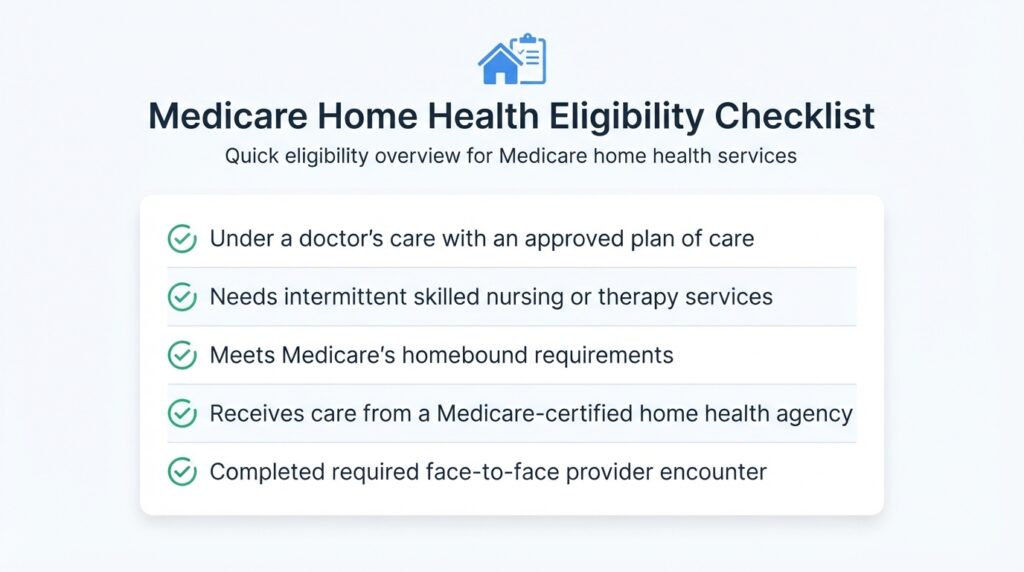
Medicare’s home health benefit is a federal program, so the rules are the same whether you live in Chicago, Springfield, or rural downstate Illinois. To qualify, you need to meet all of the following:
- You’re under the care of a doctor or an allowed practitioner, and a plan of care has been established and is reviewed regularly.
- A doctor certifies that you need one or more of: intermittent skilled nursing care, physical therapy, speech-language pathology, or continued occupational therapy.
- You’re homebound (defined below).
- The home health agency providing your care is Medicare-certified, meaning it’s been reviewed and approved by Medicare to deliver these services.
- A face-to-face encounter with your physician or authorized practitioner has occurred within the required timeframe related to the reason you need home health care.
If you meet these five conditions, Medicare Part A and/or Part B covers the home health benefit in full. There’s no separate “Illinois Medicare home health” rulebook; the Centers for Medicare & Medicaid Services (CMS) sets a single national standard, and every Medicare-certified agency in Cook, DuPage, and Will Counties follows it (Medicare.gov, Home Health Services coverage).
What “Homebound” Actually Means
This is the requirement families misunderstand most. Being homebound doesn’t mean you never leave the house. CMS defines homebound using a two-part test:
- You need supportive devices (a cane, walker, wheelchair, or crutches), special transportation, or another person’s help to leave home because of an illness or injury, and
- Leaving home isn’t medically advisable, nor is it a requirement that requires considerable and taxing effort.
You’re still considered homebound even if you leave home for medical treatment, religious services, or short, infrequent absences like a haircut, a funeral, or attending adult day care. So if your father can get to a cardiology follow-up with help but can’t reasonably run errands or attend social events without major effort, he likely meets the definition.
What Does Medicare Pay For?
Once eligibility is established, Medicare’s home health benefit covers a defined set of services. Here’s how it breaks down:
| Service | Covered by Medicare? | Notes |
| Skilled nursing care (intermittent) | Yes | Wound care, injections, monitoring, disease education |
| Physical therapy | Yes | Must be ordered by a physician |
| Occupational therapy | Yes | Helps with daily living skills and safety |
| Speech-language pathology | Yes | Covers communication and swallowing disorders |
| Medical social work | Yes | When tied to the medical plan of care |
| Home health aide services | Yes, conditionally | Covered only alongside skilled nursing or therapy not as a stand-alone benefit |
| Medical supplies used during care | Yes | Items like wound dressings used during a visit |
| Durable medical equipment | Partially | Covered under Part B, often at 80%, separate from the home health benefit |
| 24-hour home care | No | Medicare doesn’t cover round-the-clock care |
| Meal delivery | No | Not a covered home health service |
| Homemaker services (cleaning, shopping) | No | Considered non-medical/custodial care |
| Personal care as the only service needed | No | Aide visits require an accompanying skilled need |
For Chicago-area patients recovering from a stroke, joint replacement, cardiac event, or managing a chronic condition like COPD or diabetes, this typically means a mix of skilled nursing visits and therapy, often with a home health aide layered in to help with bathing, dressing, and mobility once a skilled need is established.
If your case involves coordinating benefits with a Medicare Advantage plan, the same core services apply, but prior authorization and network rules can vary by plan. Our Insurance Plans page outlines which plans we currently accept, including Humana and WellCare Medicare Advantage options.

How the Referral Process Works
Most families don’t initiate Medicare home health care on their own; a hospital discharge planner, case manager, or primary care physician typically starts the referral. Here’s how it generally moves:
- A physician identifies the need. This often happens during a hospital discharge, after a fall, or during a routine visit when a chronic condition has worsened.
- The doctor completes a face-to-face encounter and documents the medical reason why home health is necessary.
- A plan of care is created, specifying which services are needed (nursing, PT, OT, speech, aide support) and how often.
- You choose a Medicare-certified home health agency. You have the right to select your provider; hospitals can recommend one, but the choice is yours.
- The agency performs an intake assessment, usually within a day or two of referral, to confirm eligibility and finalize the care plan.
- Care begins with the agency billing Medicare directly, so you’re not paying out of pocket for covered services.
This is also where working with an agency that knows Illinois referral patterns matters. At Choice Care Home Health, we coordinate directly with discharge planners and case managers across Chicago-area hospitals so care can typically start within a day or two of referral, not a week or more.
If you’re a family member trying to get a parent into care this week, this is the moment to act. Contact Choice Care Home Health or call (708) 489-0123. Our intake team will confirm Medicare eligibility, verify your insurance, and schedule an in-home assessment.
What Medicare Doesn’t Cover (and What to Do Instead)
Medicare’s home health benefit is generous for skilled, intermittent care, but it has real limits. It won’t pay for:
- Long-term custodial care ongoing help with daily living when no skilled nursing or therapy need exists.
- 24/7 supervision or live-in care.
- Homemaker services such as cooking, cleaning, and grocery shopping are provided in isolation from medical care.
- Care delivered by a non-Medicare-certified agency.
If your family member needs more than Medicare covers, options in Illinois include Medicaid (for those who qualify financially), long-term care insurance, Veterans Affairs benefits for eligible veterans, or private-pay non-medical home care. A medical social worker on your home health team can help you understand which of these paths fits your situation and connect you with local resources in Cook, DuPage, or Will County.
For Discharge Planners and Case Managers
If you’re coordinating a discharge and need a Medicare-certified, ACHC-accredited home health partner in the Chicago area, Choice Care Home Health accepts referrals directly from hospitals, skilled nursing facilities, and physician offices. We confirm eligibility, verify insurance, including Humana and WellCare Medicare Advantage plans, and typically schedule the initial in-home assessment within one to two business days. Reach our intake team at (708) 489-0123 or through our Contact page to set up a referral pathway.
Getting Started in Chicago and the Surrounding Area
Choice Care Home Health is a Medicare-certified, ACHC-accredited agency based in Palos Hills, serving Chicago and the surrounding Cook, DuPage, and Will County communities since 2001. Our team handles the eligibility verification and paperwork so families can focus on their loved one instead of insurance forms.
If you’re trying to figure out whether your mother, father, or spouse qualifies for Medicare home health care, the fastest way to know for sure is to have a clinician evaluate the case directly. Schedule an assessment or call (708) 489-0123, and we’ll walk you through eligibility, coverage, and next steps usually within a day or two.
FAQ Section
Does Medicare cover home health aides in Illinois?
Yes, but only when the aide’s visits are paired with a skilled need like nursing or therapy. Medicare won’t pay for an aide as a stand-alone service. Once skilled care is established under your plan of care, aide visits for help with bathing, dressing, and mobility are covered at no cost to you.
What is the homebound definition for Medicare home health?
Homebound means you need help, a device, or special transportation to leave home because of illness or injury, and leaving isn’t medically advisable or requires significant effort. You can still qualify even if you occasionally leave for medical appointments, religious services, or short outings like a haircut.
What does Medicare pay for home health care?
Medicare Part A and Part B pay 100% of covered home health services with no copay or deductible, including skilled nursing, physical therapy, occupational therapy, speech therapy, medical social work, and home health aide visits tied to a skilled need. It doesn’t cover 24-hour care, homemaker services, or custodial-only care.
Do I need a hospital stay before Medicare will cover home health care?
No. While many referrals follow a hospital discharge, Medicare doesn’t require a prior hospital stay. A physician can refer you for home health directly from an office visit if you meet the skilled-care and homebound requirements.
How do I qualify for Medicare home health care in Illinois?
You qualify by being under a doctor’s care with an established plan of care, needing intermittent skilled nursing or therapy, being homebound, and having a face-to-face encounter with your physician. A Medicare-certified agency then confirms eligibility and starts services.
How fast can home health care start after a Medicare referral?
Timing varies by agency, but many Chicago-area providers, including Choice Care Home Health, can complete an intake assessment and begin care within one to two business days of receiving a referral and required documentation.
Will Medicare Advantage plans cover home health care the same way as Original Medicare?
Medicare Advantage plans must cover the same core home health services as Original Medicare, but they may require prior authorization or use a specific network of providers. Check with your plan or ask your agency to verify in-network status before care begins.