
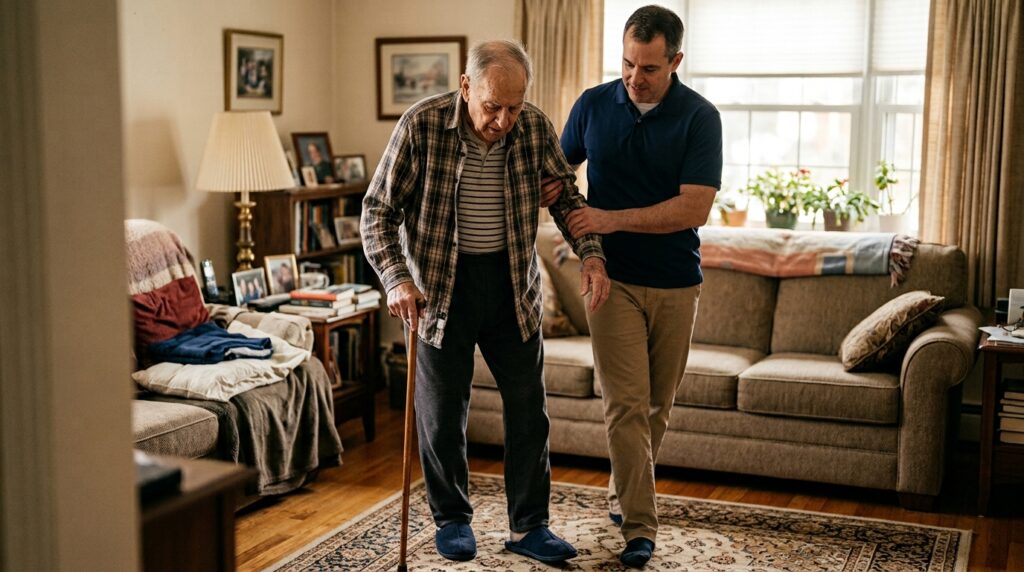
Our mom’s hands have trembled for a couple of years, and you had adjusted to that. What you did not expect was the morning she froze in the hallway of her Palos Heights home, feet stuck to the floor, unable to take a step until you talked her through it. That moment changes how a family thinks about safety.
Home health care for Parkinson’s patients brings a nurse and therapists into the home to manage medication timing, rebuild balance and strength, and make the house safer, so your loved one can stay independent longer and avoid falls. For families across Chicago and the southwest suburbs, that support usually arrives right when daily routines start getting harder to manage alone.
Key Takeaways
- Home health care for Parkinson’s patients combines skilled nursing, therapy, and home safety changes under one doctor-ordered plan.
- Medication timing matters enormously with Parkinson’s. Even a 30-minute delay can affect movement.
- Falls are the biggest safety risk, and small home changes prevent most of them.
- Physical, occupational, and speech therapy each address a different Parkinson’s symptom.
- Medicare often covers home health care for Parkinson’s at no out-of-pocket cost.
What does home health care for Parkinson’s patients include?
Parkinson’s disease is a progressive neurological condition that affects movement, causing tremor, stiffness, slowness, and balance problems. Because it touches so many parts of daily life, care at home usually involves a small team rather than one person.
A typical plan includes:
- Skilled nursing to manage medications, monitor symptoms, watch for side effects, and coordinate with the neurologist.
- Physical therapy to work on balance, gait, and strength, often through neurological physical therapy designed for conditions like Parkinson’s.
- Occupational therapy for daily tasks such as dressing, bathing, and eating, plus adaptive tools that make them easier.
- Speech therapy for the quiet, hard-to-understand speech many people with Parkinson’s develop, and for swallowing safety.
- Home health aide support with personal care and daily activities.
- Medical social work to connect families with community resources and support groups.
Nearly one million people in the United States are living with Parkinson’s disease, according to the Parkinson’s Foundation, so if your family feels alone in this, you are far from it.
Why medication timing matters more than families expect
This is the part most families learn the hard way. Parkinson’s medications work on a tight schedule, and doses are often prescribed at specific times rather than “three times a day.” When a dose runs late, symptoms can return quickly, a pattern clinicians call off time (periods when medication is not working well and movement becomes difficult).
A home health nurse builds the routine that prevents this:
- Map the exact dose times to the clock, not to meals or convenience.
- Set alarms or reminders so doses stay within their window, even by 15 or 30 minutes.
- Track symptoms against timing, noting when stiffness or freezing appears.
- Watch food interactions, since protein-rich meals can interfere with how some Parkinson’s medications are absorbed.
- Report patterns to the neurologist, who can adjust the regimen based on real observations from home.
Our guide on managing medications for seniors covers the broader system, but with Parkinson’s, the clock is the critical detail.

Making the home safer, room by room
Falls are the most serious risk. Freezing episodes, shuffling steps, and balance changes turn ordinary rooms into hazards. An occupational therapist does this assessment during a home visit, but here is what usually changes.
| Room | Common risk | What helps |
| Bathroom | Wet floors, low toilet, tub entry | Grab bars, non slip mats, raised toilet seat, shower chair |
| Bedroom | Getting up at night, low bed | Night lights, bed rail, clear path to bathroom, firm chair for dressing |
| Hallways | Freezing in doorways, narrow turns | Remove throw rugs, widen walkways, add contrasting tape at thresholds |
| Kitchen | Reaching, carrying, spills | Items at waist height, lightweight cups, a rolling cart instead of carrying |
| Stairs | Loss of balance | Handrails on both sides, good lighting, consider first floor living |
| Living room | Low soft seating | Firm chair with armrests, clear cords, furniture arranged for support |
Our fall safety tips for seniors go deeper on prevention, and much of it applies directly to Parkinson’s.
Watching your loved one struggle with balance or medication timing? Choice Care Home Health provides in-home Parkinson’s care across Chicago and the southwest suburbs. Call (708) 489-0123 to talk through what support would look like.
How care changes as Parkinson’s progresses
Parkinson’s does not stay the same, so neither should the care plan. Early on, therapy focuses on maintaining strength, mobility, and confidence, and nursing visits center on medication routines and education. As symptoms advance, the emphasis shifts toward safety, fall prevention, swallowing precautions, and more hands-on personal care from a home health aide.
That is the advantage of a home-based plan. A nurse who visits regularly notices the small changes- a slower walk, a new hesitation at the doorway, a cough while drinking- and adjusts before those turn into a hospital trip.
Families often ask whether this is the same as hiring a companion or caregiver. It is not. Home health is medical care ordered by a physician and delivered by licensed clinicians. Many families use both, with home health handling the clinical side and a private caregiver helping with daily life.
What families often miss: the non-movement symptoms
Most articles focus on tremor and walking, but the symptoms that wear families down are often the quieter ones. Knowing about them ahead of time helps you respond calmly instead of being caught off guard.
- Speech getting softer. Many people with Parkinson’s speak more quietly without realizing it. Speech therapy teaches techniques that restore volume and clarity.
- Swallowing changes. Coughing while eating or drinking is a warning sign worth reporting quickly, since it raises the risk of pneumonia.
- Sleep problems. Restless nights and daytime drowsiness are common and can affect medication schedules.
- Mood changes. Depression and anxiety are frequent with Parkinson’s and are treatable, not just an emotional reaction to the diagnosis.
- Constipation and blood pressure drops. Both are common, and sudden dizziness when standing raises fall risk.
- Caregiver fatigue. Parkinson’s care stretches over years, and the spouse or adult child carrying it needs support too. A medical social worker can point you toward local resources and support groups.
A home health nurse asks about these at every visit, because families rarely think to bring them up on their own.
Does Medicare cover home health care for Parkinson’s?
Usually, yes. If a doctor certifies that your loved one is homebound (leaving home takes considerable effort) and needs skilled nursing or therapy, Medicare’s home health benefit typically covers care at no out-of-pocket cost. Our guide to Medicare home health care in Illinois explains how eligibility works, and the official Medicare home health services page lays out the federal rules.
Once a physician’s order is in place, care can often begin within a day or two, which matters after a fall or a hospital stay when the risk of another incident is highest.
Starting Parkinson’s home care near Chicago
Choice Care Home Health is a Medicare-certified and ACHC-accredited home health agency serving Chicago and the southwest suburbs, including Palos Heights, Palos Hills, and Orland Park, across Cook, DuPage, and Will Counties. Our clinicians care for patients with Parkinson’s alongside other conditions like stroke, dementia, CHF, COPD, and diabetes, and we coordinate directly with your neurologist.
Chicago winters add a real complication for Parkinson’s families, since icy walkways and shorter days raise fall risk and make travel to outpatient therapy difficult. Bringing therapy into the home removes that barrier entirely.
For discharge planners, case managers, and neurologists: we accept Parkinson’s referrals across the southwest suburbs and can coordinate a prompt start of care. Call (708) 489-0123 or reach us through our contact page.
For families: you do not have to manage this alone or wait for the next fall. Call (708) 489-0123 or explore our full home health services to see how we can help.
FAQ
How does home health care help someone with Parkinson’s?
Home health care helps Parkinson’s patients by sending a skilled nurse and therapists into the home to manage medication timing, improve balance and mobility, address speech and swallowing changes, and make the house safer. This combination reduces fall risk, keeps symptoms better controlled, and helps people stay independent at home longer.
Does Medicare cover home health care for Parkinson’s patients?
In most cases, yes. If a physician certifies that the patient is homebound and needs skilled nursing or therapy, Medicare’s home health benefit typically covers the care at no out of pocket cost. Many Medicare Advantage and private insurance plans also cover home health, though prior authorization may be required first.
Why is medication timing so important with Parkinson’s?
Parkinson’s medications are prescribed at specific clock times, and even a short delay can bring symptoms back, a pattern known as off time. Late doses can cause stiffness, tremor, or freezing episodes that raise fall risk. A home health nurse builds a reliable schedule and reports timing patterns to the neurologist for adjustment.
What home safety changes help prevent falls with Parkinson’s?
The most effective changes are removing throw rugs, adding grab bars and non slip mats in the bathroom, improving lighting and night lights, installing handrails on both sides of stairs, and using firm chairs with armrests. An occupational therapist assesses the home during a visit and recommends changes specific to your loved one.
Can physical therapy help Parkinson’s disease?
Yes. Physical therapy for Parkinson’s focuses on balance, walking, posture, and strength, and therapists use specific techniques to address freezing and shuffling. Therapy does not stop the disease, but it can improve mobility, reduce fall risk, and help people stay active and independent longer, especially when started early and continued consistently.
Is home health care the same as hiring a caregiver for Parkinson’s?
No. Home health care is medical care from licensed nurses and therapists, ordered by a doctor and often covered by Medicare. A private caregiver provides nonmedical help with daily tasks like bathing, meals, and companionship. Many Parkinson’s families use both, since the needs are different and complementary.
When should a family consider home health care for Parkinson’s?
Consider it after a fall, a hospital stay, a noticeable decline in walking or balance, trouble managing medications on schedule, or when swallowing or speech changes appear. You do not have to wait for a crisis. A physician can order an assessment any time symptoms start outpacing what the family can safely manage.