
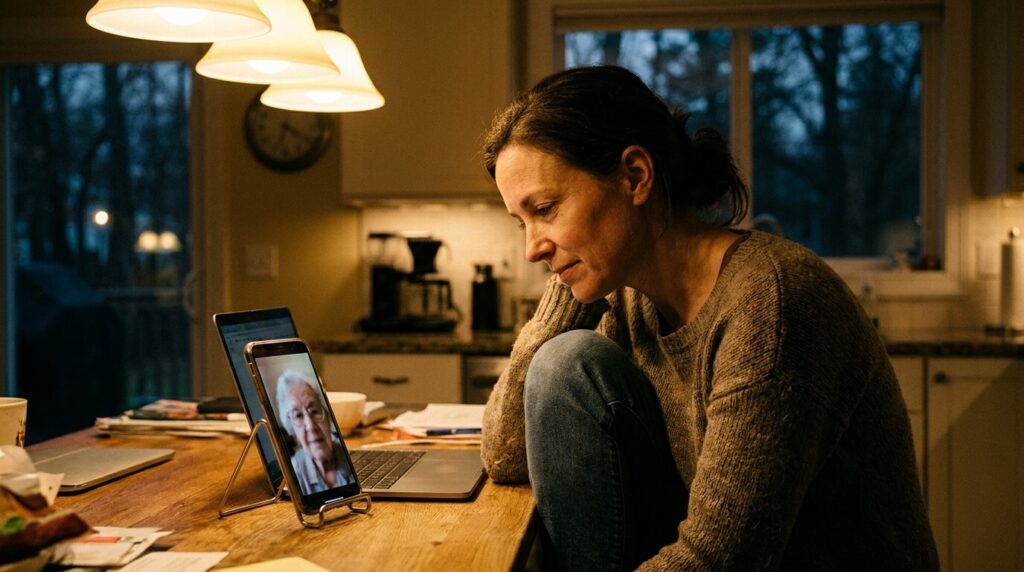
It’s 9 pm on a Tuesday, and Maria is on the phone with her mother in Orland Park, Illinois, listening carefully to how tired her voice sounds, three states away from being able to just drive over and check. That instinct, noticing something’s off from hundreds of miles away and not knowing quite what to do about it, is what long-distance caregiving actually feels like most days.
Long-distance caregiving means coordinating care and support for an aging parent from an hour or more away, using phone calls, video visits, paperwork, and a trusted local team instead of daily hands-on help. It’s real caregiving, even without the daily physical presence, and it comes with its own specific challenges around communication, trust, and knowing when a phone call isn’t enough anymore.
This guide walks through what long-distance caregiving actually involves, the warning signs that are easy to miss from far away, how to build a local support team before you need one, and how home health services in the Chicago area, including Cook, DuPage, and Will counties, can become that team.
Key Takeaways
- Long-distance caregiving means managing a parent’s care remotely, not providing hands-on help yourself, and it’s a distinct and demanding role in its own right.
- More than 10 percent of family caregivers live an hour or more from the person they care for, according to a report from AARP and the National Alliance for Caregiving.
- A local point of contact, whether a sibling, neighbor, or professional home health agency, is usually the single most important piece of a long-distance care plan.
- Choice Care Home Health, a Medicare-certified, ACHC-accredited agency serving Chicago, Palos Heights, Palos Hills, Orland Park, and the surrounding Cook, DuPage, and Will County communities, can serve as that local team once a parent needs more than a phone call can provide.
- Call (708) 489-0123 to talk through what local support could realistically look like for your family.
What Is Long-Distance Caregiving, Exactly?
According to the National Institute on Aging, long-distance caregivers support a parent or loved one even though they don’t live nearby, and the work is real, just structured differently than in-person caregiving. Common tasks include managing finances and insurance claims, arranging in-home care by hiring formal caregivers, ordering medical equipment and supplies, researching a parent’s health conditions, helping with advance care planning, organizing important paperwork, and researching long-term care options when the time comes.
This is more common than most people realize. Family caregivers now number 63 million Americans, an increase of nearly 50 percent since 2015, and while three out of four caregivers live with the person they’re caring for or within 20 minutes, more than 10 percent live an hour or more away, according to a caregiving report from AARP and the National Alliance for Caregiving. If you’re managing your parent’s care from Denver, Dallas, or even just the other side of Illinois, you’re part of a large and growing group, not an outlier.
Signs Your Parent May Need More Support Than a Phone Call Can Tell You
Phone calls are honest, but they’re also easy to perform. A parent who wants to reassure you will often say they’re fine even when they’re not, and some warning signs simply don’t come across in a voice. Here’s what to actually check for during a video call or visit, rather than just asking how things are going:
- Look at their kitchen and living space during a video call. Piled-up mail, expired food, or a noticeably messier home than usual can signal declining energy or mobility.
- Ask specifically about medications, not generally. “Did you take your morning pills today?” gets a more honest answer than “are you keeping up with your medicine okay?”
- Notice their appearance and weight. Weight loss, the same clothes worn repeatedly, or a general lack of grooming can point to depression, cognitive decline, or physical difficulty with daily tasks.
- Ask a neighbor or a trusted local contact to check in occasionally in person. A five-minute in-person visit often reveals what a 30-minute phone call doesn’t.
- Pay attention to repeated stories or confusion about recent events. Occasional forgetfulness is normal, but a pattern of confusion about dates, medications, or conversations is worth a real conversation with their doctor.
If more than one or two of these show up consistently, it’s usually a sign that remote check-ins alone aren’t enough anymore, and it’s time to build a more formal local support system.
How to Build a Long-Distance Care Team
Most families build this reactively, after a fall or a hospital stay, rather than proactively. Setting it up before a crisis makes an enormous difference in how smoothly everything else goes.
- Identify a local point of contact first. This might be a sibling, a close family friend, a neighbor, or a professional case manager. This person becomes your eyes and ears, and everyone else’s information funnel.
- Get legal and medical paperwork in order. A power of attorney (a legal document that lets someone you trust make financial or medical decisions on your behalf if you’re unable to) and a HIPAA release (a signed form that gives your parent’s doctors permission to share medical information with you directly) are the two documents that make everything else possible. Without them, even a hospital may not be able to legally update you.
- Set up simple remote monitoring tools. A medication reminder app, a video doorbell, or a medical alert pendant with fall detection can catch problems between calls without feeling invasive.
- Establish a predictable check-in rhythm. A regular time, not just “whenever,” makes it easier to notice when something’s actually different rather than guessing from inconsistent conversations.
- Build a relationship with a local home health agency before you need one. Knowing who to call and having already discussed your parent’s situation saves precious time during an actual emergency or hospital discharge.
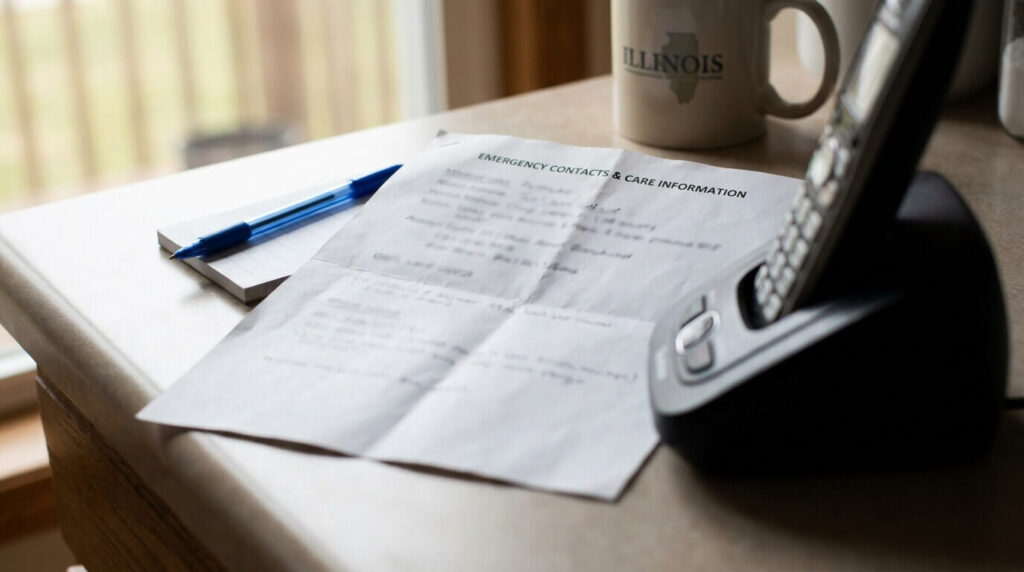
- Confirm who to call in a true emergency, and make sure that number is posted somewhere visible in your parent’s home, not just saved in your phone three states away.
When to Bring In Professional In-Home Support
At some point, remote coordination reaches its limit, usually around a specific medical need rather than a general sense that things are getting harder. This is where a home health aide (a trained caregiver who helps with bathing, dressing, meal preparation, and light housekeeping), skilled nursing (medical care such as wound care or medication management provided by a licensed nurse), or services like physical therapy, occupational therapy, speech therapy, and medical social work (a service that helps families navigate care planning, community resources, and emotional support) come in.
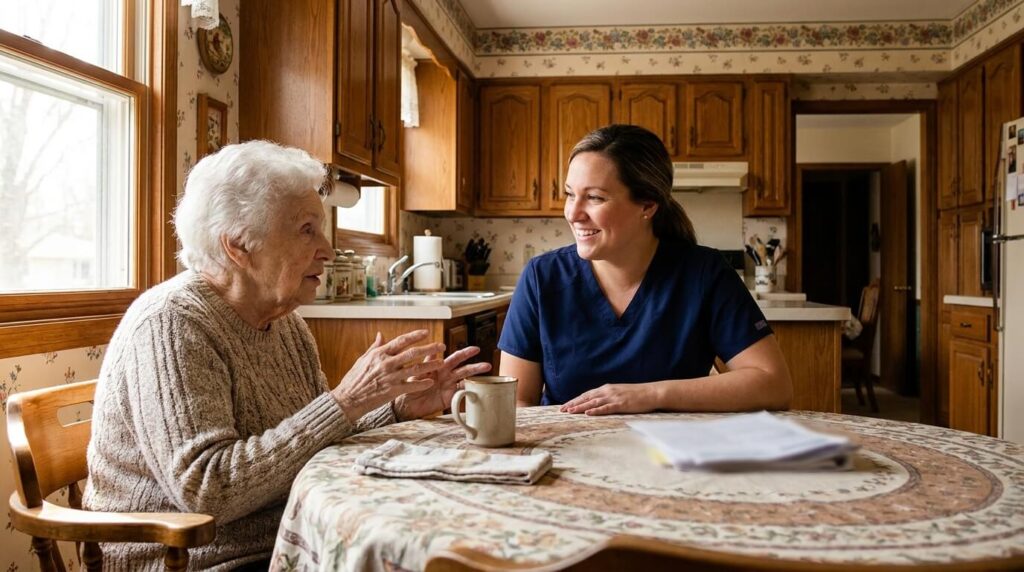
Medicare can cover home health care when a physician certifies that your parent is homebound, meaning, according to Medicare’s own coverage guidelines, that leaving home isn’t recommended because of their condition or requires significant help and effort, and they need part-time or intermittent skilled care. Not every situation meets this bar, which is exactly why it’s worth understanding the difference between what a family member can manage remotely and what genuinely needs someone local and in person.
| Task | Can Often Be Managed Remotely | Usually Needs Someone Local |
| Paying bills and managing finances | Yes | No |
| Researching care options and insurance coverage | Yes | No |
| Daily medication reminders and supervision | Partially, with technology | Yes |
| Noticing physical decline, falls, or hygiene changes | No | Yes |
| Bathing, dressing, and personal care assistance | No | Yes |
| Wound care, injections, or other skilled medical tasks | No | Yes |
| Attending doctor appointments and asking follow-up questions | Partially, by phone | Yes, ideally in person |
If your parent’s needs are landing on the right side of that table more often than the left, that’s usually the signal that it’s time to bring in a home health aide or nursing support rather than trying to stretch remote coordination further than it can reasonably go.
Choice Care Home Health’s home health aide services, intermittent skilled nursing, and medical social work team can become the local presence you can’t be yourself, with regular updates back to you so you’re never guessing what’s actually happening at home. If your family is trying to figure out where your parent should go next after a hospital stay, our guide on getting home health care for an elderly parent in Chicago walks through that decision in more depth.
Call us at (708) 489-0123 if you want to talk through what a realistic care plan looks like for your specific situation, even if you’re not ready to start services yet.
Medicare, Medicaid, and Paying for Home Health Care From Far Away
Cost and coverage confusion is one of the biggest things that stalls long-distance families from acting, simply because it’s hard to research clearly from a distance and under stress. Medicare can cover home health care under CMS (Centers for Medicare & Medicaid Services) guidelines when your parent meets the homebound and skilled-care requirements described above. Medicaid and other Illinois-specific programs can help when Medicare alone isn’t enough or doesn’t apply. Our full breakdown of Medicare home health care coverage in Illinois and our guide to paying for home health care without Medicare cover private pay, VA benefits, and Illinois Medicaid waivers in detail, so you’re not trying to piece this together from scratch while also managing everything else.
How Fast Can Home Health Care Start in Illinois?
This is usually the second biggest concern, right after cost, especially if your parent is being discharged from the hospital and you’re not there in person to help manage the transition. Home health care generally starts once a physician provides a referral and an initial in-home assessment is completed. As a Medicare-certified, ACHC-accredited agency, we work directly with hospital discharge planners and case managers to coordinate this as efficiently as possible, but exact timing depends on your parent’s specific situation and current availability, so the most accurate answer is a direct phone call rather than a general promise.
For Discharge Planners and Case Managers Coordinating With an Out-of-State Family
If you’re a discharge planner or case manager working with a family member who lives out of state, that distance often adds real friction to an already tight discharge timeline. Choice Care Home Health works directly with hospital care teams across Chicago, Cook, DuPage, and Will counties, and we’re comfortable coordinating updates with a primary contact who isn’t physically present, through phone calls, care summaries, and a consistent point of contact on our end. Call (708) 489-0123 to discuss a specific discharge or ongoing case.
The Bottom Line
Long-distance caregiving is genuinely harder in some ways than caregiving in person, mostly because so much of it runs on trust in people you can’t see every day. The families who manage it best usually aren’t the ones with the most money or the most free time; they’re the ones who built a real local team, whether that’s a sibling, a neighbor, or a professional home health agency, before a crisis forced the issue.
If you’re trying to figure out what that team should look like for your family, call Choice Care Home Health at (708) 489-0123. We’re a Medicare-certified, ACHC-accredited home health agency serving Chicago, Palos Heights, Palos Hills, Orland Park, and the surrounding Cook, DuPage, and Will County communities, and we can talk through what local support could realistically look like, whether that’s starting services now or simply having a plan ready for later.
This article is for general educational purposes and isn’t a substitute for personalized medical, legal, or financial advice. Talk with your parent’s physician, an elder law attorney, or a qualified financial advisor about decisions specific to your family’s situation.
FAQ SECTION
What is long-distance caregiving?
Long-distance caregiving is coordinating care and support for an aging parent or loved one from an hour or more away, rather than providing hands-on daily help in person. It includes tasks like managing finances, researching care options, arranging in-home help, and staying involved through phone calls and video visits, and it affects more than 10 percent of family caregivers nationally.
How do I know if my parent needs more help than I can provide from far away?
Watch for a messier home than usual, weight loss or changes in grooming, confusion about recent events, or difficulty managing medications correctly. If more than one or two of these show up consistently during calls or visits, it’s usually time to bring in local, in-person support rather than relying on remote check-ins alone.
Can Medicare pay for home health care if I don’t live near my parent?
Yes, Medicare coverage isn’t affected by where you live. It depends on whether your parent meets Medicare’s homebound and skilled-care requirements, which a physician must certify. Our guide to Medicare home health coverage in Illinois walks through exactly what that requires.
What should I look for in a local home health agency if I live out of state?
Look for an agency that’s Medicare-certified and accredited by a recognized body like ACHC, communicates proactively rather than only when you call, and is comfortable coordinating with a primary contact who isn’t physically present. Ask directly how they handle updates for out-of-state family members before choosing one.
What legal documents does a long-distance caregiver need?
A power of attorney, which lets you make financial or medical decisions on your parent’s behalf if needed, and a HIPAA release, which lets doctors share medical information with you directly, are the two most important. Without these, providers may not be legally able to update you, even in an emergency.
How do long-distance caregivers stay involved day to day?
Most rely on a predictable check-in schedule, simple technology like medication reminder apps or video doorbells, a trusted local contact for in-person checks, and a professional home health agency once medical or personal care needs go beyond what phone calls can manage.
How fast can home health care start once my parent is discharged from the hospital?
It depends on the physician referral and initial assessment process, which can often move quickly when a hospital discharge planner and the home health agency coordinate directly. The most accurate timeline comes from a direct call to the agency about your parent’s specific situation.