

You’ve already had the conversation with Medicare, or with an agency that checked eligibility for you, and the answer wasn’t what you hoped. Your loved one’s situation doesn’t meet Medicare’s homebound and skilled-care requirements, or the care they need is custodial rather than medical, and now you’re left with the harder question: how does a family actually pay for this?
The honest answer is that there’s no single program that replaces Medicare here. What there is, is a set of real options, some well known, some easy to miss, that cover different situations. This guide walks through each one plainly: what it actually covers, who qualifies, and where it falls short, so you can figure out which combination applies to your family rather than guessing. As a Medicare-certified, ACHC accreditation home health agency serving Chicago, Orland Park, Palos Hills, Palos Heights, Tinley Park, Oak Lawn, and the rest of Will County, we’ve walked plenty of families through exactly this after a “Medicare won’t cover it” conversation.
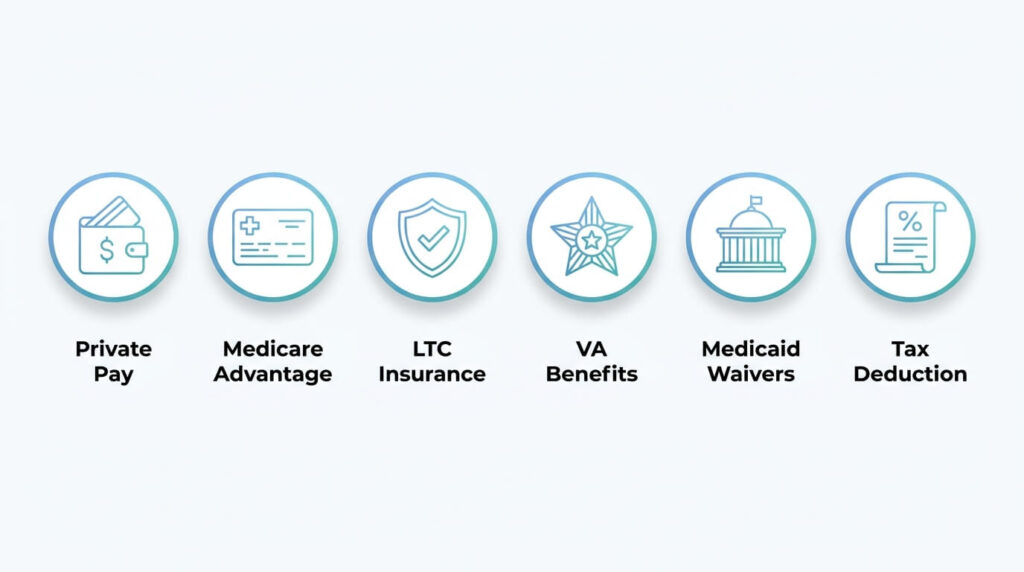
Payment Options at a Glance
| Payment Option | What It Covers | Who Qualifies | Typical Timeline |
|---|---|---|---|
| Private Pay | Any care need, medical or custodial, no restrictions | Anyone who can pay out of pocket | Can start within days |
| Medicare Advantage Supplemental Benefits | Limited in-home support hours, varies by plan | Enrolled in a Medicare Advantage plan that includes the benefit | Immediate if already enrolled, benefit details vary by plan |
| Long-Term Care Insurance | Custodial and personal care, homemaker services, adult day care | Policyholders who meet the policy’s benefit trigger | Weeks, once a claim and benefit trigger are verified |
| VA Aid and Attendance | Monthly payment toward in-home care, assisted living, or nursing home care | Veterans or surviving spouses with a VA pension who meet the medical criteria | Months, application and review dependent |
| Illinois Medicaid Waivers | In-home personal care, homemaker services, and related community-based support | Seniors who meet financial and medical eligibility requirements | Weeks to months, financial and medical determination required |
| Medical Expense Tax Deduction | The portion of qualified long-term care costs above 7.5% of adjusted gross income | Chronically ill individuals receiving care under a licensed practitioner’s plan of care | Annual, applied at tax filing time |
Why Medicare Isn’t Covering This
Before looking at alternatives, it helps to know why the door closed in the first place. Medicare’s home health benefit is built around skilled, physician-ordered care for a homebound patient, things like nursing, physical therapy, or speech-language pathology under a plan of care. If your loved one’s need is custodial- help with bathing, meals, or supervision- without a skilled medical component, or if they don’t meet the homebound standard, Medicare’s home health benefit generally won’t apply, based on Medicare’s official home health coverage guidelines. That’s not a loophole or a mistake; it’s simply outside what that specific benefit was designed to pay for, and it’s exactly the gap the options below exist to fill.
Private Pay: The Default, and What It Actually Costs
Most families end up here first, simply because it doesn’t require an application or an eligibility determination. In the Chicago area, private-pay non-medical home care generally runs $30 to $40 per hour. At $35 an hour, that works out to roughly $1,050 a month for a few check-in visits (about 7 hours a week), roughly $2,275 a month for part-time daily support (about 15 hours a week), and roughly $4,550 a month for substantial daily care (about 30 hours a week). We break these numbers down in more detail, alongside what Medicare does and doesn’t cover, in our Home Health Care Cost in Illinois guide.
Private pay’s advantage is speed and flexibility; care can usually start within days, and hours can flex up or down as needs change. Its obvious downside is cost, especially for families who need substantial hours over a long stretch. For a lot of families, private pay ends up being a bridge, covering the gap while a Medicaid application, VA claim, or insurance policy is being processed, rather than the only plan.
Medicare Advantage: Sometimes More Than Original Medicare
If your loved one has a Medicare Advantage plan rather than Original Medicare, it’s worth checking directly with that plan before assuming the answer is the same. Some Medicare Advantage plans include limited supplemental benefits beyond Original Medicare’s home health coverage, such as a set number of hours of in-home support or help with certain daily tasks, though this varies significantly by plan and isn’t guaranteed. Choice Care works with Humana and WellCare Medicare Advantage plans and can help you understand what a specific plan actually includes rather than what its brochure implies.
Long-Term Care Insurance
If your loved one purchased a long-term care insurance policy years ago, this is worth checking even if nobody remembers the details. Long-term care insurance policies are specifically designed to cover custodial care, the exact category Medicare excludes, including in-home personal care, homemaker services, and adult day care, once a policy’s benefit trigger is met (typically needing help with a certain number of activities of daily living, or a cognitive impairment diagnosis). Coverage details, waiting periods, and daily or monthly benefit caps vary enormously by policy, so the first step is simply pulling the actual policy document and calling the insurer to confirm what it covers, rather than assuming based on the policy’s general description.
VA Benefits: Aid and Attendance and More
For veterans and their surviving spouses, VA benefits are often the most overlooked resource in this entire list. The VA Aid and Attendance benefit adds a monthly payment on top of an existing VA pension for veterans or survivors who need help with daily activities like bathing, dressing, or eating, or who have a severe vision impairment. It’s specifically designed to help offset the cost of in-home care, assisted living, or a nursing home, and it’s paid directly to the veteran or survivor rather than restricted to a specific provider. Eligibility requires an existing VA pension and meeting the benefit’s medical criteria, and applying involves VA Form 21-2680 along with the standard pension application. It’s a genuinely underused benefit; many eligible families never apply simply because they don’t know it exists.
Illinois Medicaid Waivers: Help for Those Who Qualify Financially
For families with limited income and assets, Illinois has more than one Medicaid-funded path to in-home support, and they work differently from each other.
The Illinois Persons Who Are Elderly waiver, administered through Illinois’ Home and Community-Based Services program, can cover in-home care for seniors who qualify financially and medically, including custodial care that Original Medicare wouldn’t touch.
Separately, the Illinois Community Care Program, run through the Illinois Department on Aging, is specifically built to help seniors avoid nursing home placement by covering in-home services (help with household tasks and personal care), an emergency home response system, adult day service, and an automated medication dispenser. It’s open to Illinois residents 60 and older with non-exempt assets of $17,500 or less, who have an assessed need for long-term care and are eligible for Medicaid.
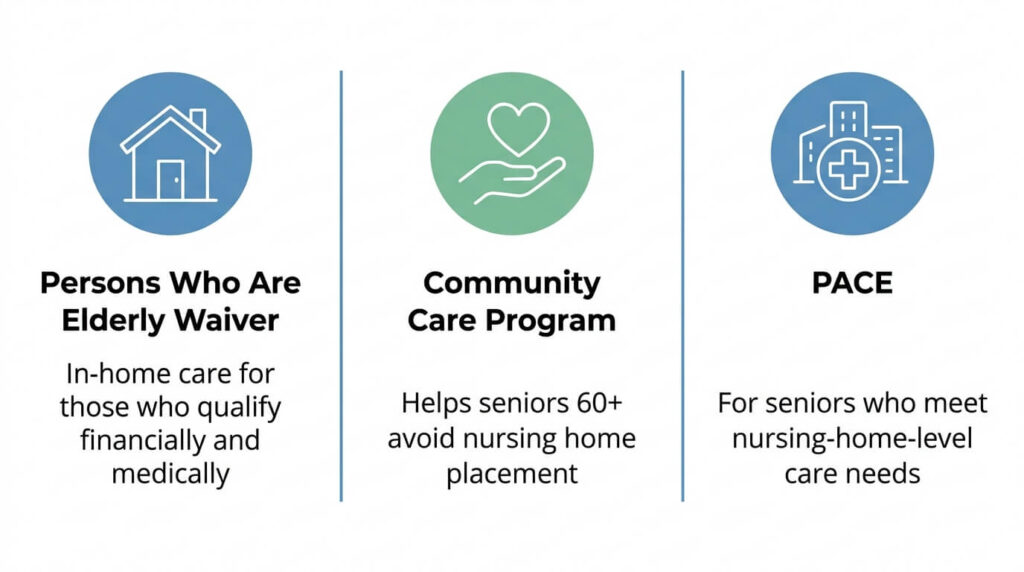
For seniors whose needs are more extensive, closer to what a nursing home would provide, the PACE program (Program of All-Inclusive Care for the Elderly) has recently expanded into Illinois, covering seniors who meet nursing-home-level care criteria but want to stay in the community, with services delivered across home visits, a PACE day center, and coordinated care around the clock. As of this writing, PACE in Illinois is available in West Chicago, South Chicago, Southern Cook County, Peoria, and East St. Louis, so availability depends on where your loved one lives.
Since these three programs get confused with each other often, here’s how they compare side by side:
| Program | Who It’s For | What It Covers | Key Eligibility |
|---|---|---|---|
| Persons Who Are Elderly Waiver | Seniors who need in-home care and qualify financially and medically | In-home care, including custodial care that Original Medicare does not cover | Financial and medical qualification through Illinois’ Home and Community-Based Services program |
| Illinois Community Care Program | Seniors 60 and older at risk of nursing home placement | In-home services, an emergency home response system, adult day service, and an automated medication dispenser | Age 60+, non-exempt assets of $17,500 or less, Medicaid eligible, assessed need for long-term care |
| PACE | Seniors who meet nursing-home-level care needs but want to stay in the community | Home visits, a PACE day center, and coordinated care around the clock | Meets nursing-home-level care criteria, and lives in an available service area (West Chicago, South Chicago, Southern Cook County, Peoria, or East St. Louis) |
None of these programs are quick. Each involves a financial and medical eligibility determination, and approval can take weeks. If your family might qualify, it’s worth starting the application even while using private pay to cover the gap in the meantime. If your family is also weighing whether to stay at home at all, our Aging in Place vs. Assisted Living guide covers how these same Medicaid programs fit into that broader decision.
Can You Deduct Home Care Costs on Your Taxes?
Sometimes, yes, though the rules are specific. Under IRS guidance on medical and dental expenses, qualified long-term care services, including in-home personal care, can be deductible as a medical expense when the care is required by a chronically ill individual and provided under a plan of care from a licensed health care practitioner. “Chronically ill” has a specific meaning here: certification within the prior 12 months that the person needs substantial help with at least two activities of daily living for 90 days or more, or needs substantial supervision due to severe cognitive impairment. Even when it qualifies, the deduction only applies to the portion of total medical expenses exceeding 7.5% of adjusted gross income, so this rarely covers the full cost, but it can meaningfully offset it. This is a good one to review with a tax professional rather than assume either way.
Other Ways Families Bridge the Gap
A few less formal options come up often enough to mention. Family caregiving, with or without a formal caregiver agreement and payment arrangement, covers a real share of care nationally, though it comes with its own burnout risk worth taking seriously. Home equity, through a reverse mortgage or home equity line of credit, is a path some families use to fund care while allowing a parent to stay in their own home, though it carries real long-term financial tradeoffs that deserve a conversation with a financial advisor before moving forward. And for veterans, state, or union retirees with a pension, checking whether that specific plan includes any long-term care or in-home care benefit is worth a phone call, since it’s not always advertised clearly.
Putting Together a Payment Plan
Most families don’t end up using just one of these. A realistic plan is often layered: private pay covering the first few weeks while a Medicaid waiver or VA claim is in process, a Medicare Advantage supplemental benefit covering a portion of hours, and a tax deduction offsetting some of the cost at year end. The starting point is an honest inventory: what does your loved one actually need help with, what’s the realistic monthly cost of that, and which of the programs above they might actually qualify for. From there, it’s a matter of applying to more than one at once rather than waiting on one answer before trying another.
If you’d rather talk through your specific situation than piece it together from articles like this one, call us. We can’t approve a Medicaid waiver or a VA claim, but we can tell you plainly what’s medically involved, help you understand your insurance options, and point you toward the right program to apply to.
Frequently Asked Questions
What are my options if Medicare won’t cover home health care?
Private pay, Medicare Advantage supplemental benefits, long-term care insurance, VA Aid and Attendance for veterans and survivors, Illinois Medicaid waivers like the Persons Who Are Elderly waiver and the Community Care Program, and in some cases a medical expense tax deduction.
How much does private-pay home care cost in Illinois?
Generally $30 to $40 per hour in the Chicago area, which works out to roughly $1,050 to $4,550 a month depending on how many hours per week are needed.
Does the VA pay for home care?
The VA Aid and Attendance benefit adds a monthly payment to an existing VA pension for qualifying veterans and survivors who need help with daily activities, and that payment can be used toward in-home care, among other care options.
Does Medicaid pay for home care in Illinois?
It can, through programs like the Illinois Persons Who Are Elderly waiver and the Illinois Community Care Program, for those who meet financial and medical eligibility requirements.
Is home care tax deductible?
Sometimes. In-home care can qualify as a deductible medical expense under IRS rules when it’s required by a chronically ill individual under a licensed practitioner’s plan of care, though only the portion of total medical expenses above 7.5% of adjusted gross income is deductible.
Does long-term care insurance cover home care?
Most long-term care insurance policies do cover in-home personal care once a policy’s benefit trigger is met, but coverage amounts, waiting periods, and daily limits vary by policy, so it’s worth confirming directly with the insurer.
What is the Illinois Community Care Program?
A state program through the Illinois Department on Aging that helps seniors 60 and older avoid nursing home placement by covering in-home services, an emergency response system, adult day service, and medication management, for those who meet income, asset, and medical eligibility requirements.
What is PACE and is it available in Illinois?
PACE (Program of All-Inclusive Care for the Elderly) is a comprehensive care program for seniors who meet nursing-home-level care needs but want to stay in the community. It has recently expanded into Illinois, currently available in West Chicago, South Chicago, Southern Cook County, Peoria, and East St. Louis.
The Bottom Line
A “Medicare won’t cover this” answer feels like a dead end, but it usually isn’t one. Between private pay, Medicare Advantage supplemental benefits, long-term care insurance, VA benefits, Illinois Medicaid waivers, and the tax code, most families can put together a real plan, it’s just rarely one single program doing all the work. The fastest way to figure out which combination fits your family is to talk through the specific situation with someone who can point you to the right applications, rather than trying to research every program from scratch.
Call Choice Care Home Health at (708) 489-0123. We’re a Medicare-certified, ACHC accreditation agency serving Chicago, Orland Park, Palos Hills, Palos Heights, Tinley Park, Oak Lawn, and Will County, and while we can’t approve your Medicaid or VA application, we can help you understand exactly what your loved one’s situation requires and where to take it next.