

Your mom just got discharged from the hospital after a fall, and the discharge planner handed you a folder of paperwork and said, She’ll need some help at home. That’s it. No roadmap, no timeline, just you, a folder, and a parent who insists she’s “fine.”
If that’s where you are right now: to get home health care for an elderly parent in Chicago, you’ll need a doctor’s order confirming the care is medically necessary, an in-home assessment from a Medicare-certified agency, and confirmation that your parent is “homebound” under Medicare’s definition. Most families in Cook, DuPage, and Will Counties can have a nurse or therapist in the home within 24 to 48 hours after the referral is processed.
That’s the short version. Here’s everything underneath it: what counts as homebound, what Medicare actually pays for, how to tell the difference between home health care (skilled, medical) and home care (non-medical companionship), and the exact questions to ask before you pick an agency.
Key Takeaways
- A physician’s order plus a face-to-face visit are required before Medicare will cover home health services; you can’t self-refer.
- “Homebound” doesn’t mean bedbound; it means leaving home requires considerable effort or assistance and outings are infrequent.
- Medicare Parts A and/or B typically cover 100% of medically necessary home health visits with no copay when ordered correctly.
- Home health care (skilled nursing, therapy) is different from non-medical home care (bathing, meals, companionship); many families need both.
- A same-week start is realistic in the Chicago area once a referral and assessment are in motion.
Signs Your Parent Needs Home Health Care
Adult children often wait too long because the signs are gradual, not dramatic. Watch for:
- A recent hospital stay, ER visit, or new diagnosis (stroke, heart failure, joint replacement, wound, infection)
- Missed medications or confusion about dosages
- Unexplained weight loss or a noticeable drop in mobility
- New difficulty with bathing, dressing, or getting up from a chair
- A fall, or a “near miss,” your parent downplays
- A spouse or caregiver who seems exhausted or overwhelmed
If your parent’s doctor recently changed a treatment plan, or you’ve noticed two or more of the signs above, it’s worth asking the physician directly: “Would home health services help here?”

Home Health Care vs. Home Care: Know the Difference
This is the single most common point of confusion for families, so it’s worth a direct table.
| Home Health Care | Home Care (Non-Medical) | |
| Who provides it | Registered nurses, physical/occupational/speech therapists, medical social workers | Home health aides, companions, personal care aides |
| What it covers | Wound care, medication management, therapy, skilled monitoring | Bathing, dressing, meal prep, companionship, light housekeeping |
| Requires a doctor’s order | Yes | No |
| Typically covered by Medicare | Yes, when medically necessary | Generally, no (private pay or long-term care insurance) |
| Duration | Intermittent, tied to a medical plan of care | Can be ongoing and flexible |
Many families end up needing both skilled care for the medical piece plus non-medical support for daily living. Ask your agency whether they coordinate both or can refer you to a trusted non-medical partner.
Does Medicare Cover Home Health Care in Illinois?
Yes, when the eligibility criteria are met, Medicare Part A and/or Part B covers home health services at 100%, with no copay or deductible for the home health visits themselves. According to the Centers for Medicare & Medicaid Services, roughly 8% of all Medicare fee-for-service beneficiaries used home health services in a recent reporting year, served by over 11,000 Medicare-certified agencies nationwide (CMS, Medicare Home Health Agency statistics). Durable medical equipment and medical supplies tied to the plan of care are typically covered too, though Medicare does have a 20% coinsurance for certain DME.
If your parent has a Medicare Advantage plan instead of Original Medicare, coverage rules can vary slightly by plan, so it’s worth a quick call to confirm.
Need help figuring out what your parents’ plan actually covers? Contact our care team; w we’ll walk through eligibility with you before you commit to anything.
How to Choose a Home Health Agency in Chicago
Not all agencies are equal, and the right fit matters as much as the credentials. Look for:
- Medicare certification and accreditation (ACHC, Joint Commission, or CHAP)
- Local presence in Cook, DuPage, or Will County, with nurses who know the area’s hospitals and discharge teams
- Clear communication about who’s coming, when, and what they’ll do
- Care team continuity: the same nurse or aide whenever possible, rather than a rotating cast of strangers
- Transparent answers about coverage, costs, and what happens if your parent’s needs change
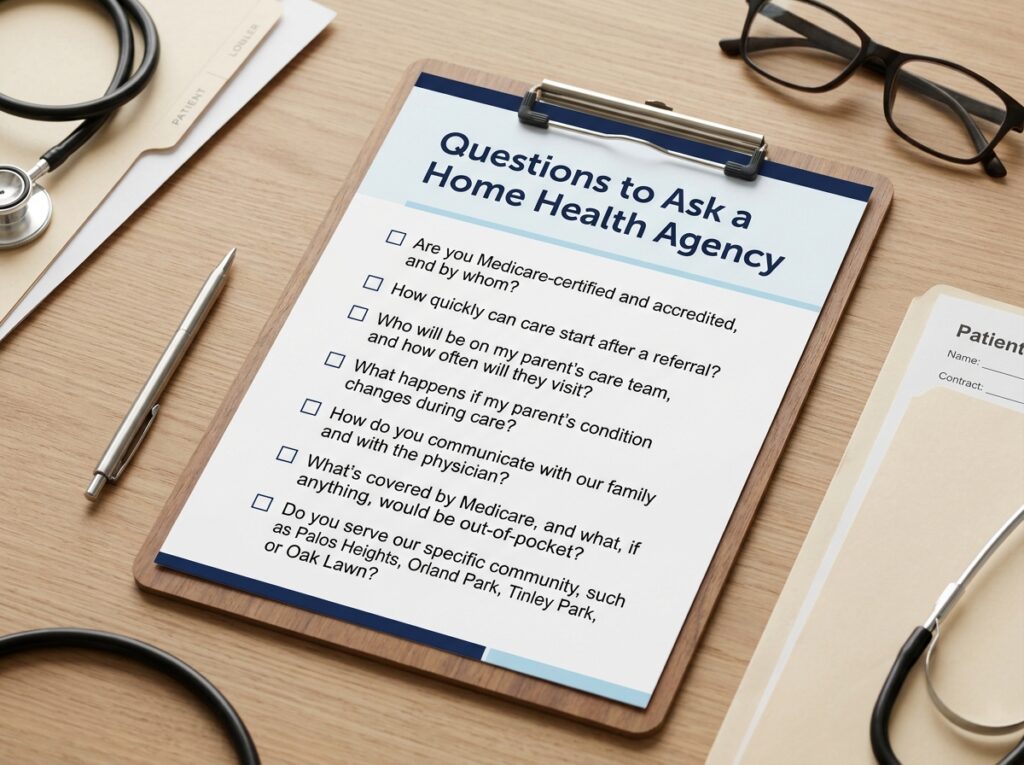
Questions to Ask a Home Health Agency
Before you sign anything, ask:
- Are you Medicare-certified and accredited, and by whom?
- How quickly can care start after a referral?
- Who will be on my parents’ care team, and how often will they visit?
- What happens if my parents’ condition changes mid-care?
- How do you communicate with our family and with the physician?
- What’s covered by Medicare, and what (if anything) would be out-of-pocket?
- Do you serve our specific town, Palos Heights, Orland Park, Tinley Park, or Oak Lawn?
A reputable agency will answer all of these clearly and without hesitation.
Caregiver Resources in Chicago and Illinois
You’re not handling this alone, even if it feels that way at 11 p.m. with a folder of discharge papers. Nationally, family caregivers are carrying an enormous and growing load. The 2025 Caregiving in the US report from AARP and the National Alliance for Caregiving found that 63 million Americans are now family caregivers, a nearly 50% increase since 2015, and nearly 1 in 5 caregivers report their own health has suffered because of it (AARP/NAC, Caregiving in the US 2025).
Illinois-based support includes your local Area Agency on Aging (covering Cook, DuPage, and Will counties), the Illinois Department on Aging’s Senior HelpLine, and hospital-based discharge planning teams, who can often point you toward respite care and caregiver support groups in addition to home health referrals.
Feeling stretched thin already? That’s common, and it’s also exactly the kind of thing a medical social worker on a home health team can help you navigate, connecting your family to local resources, not just managing your parent’s medical needs.
What This Costs, and Who Pays
This is usually the second question after “how fast can we start?” When home health is ordered by a physician and meets Medicare’s medical necessity and homebound criteria, Original Medicare pays the full cost of covered home health visits, with no deductible and no coinsurance on the visits themselves. Non-medical home care (companionship, help with chores) generally isn’t Medicare-covered and is typically private pay, long-term care insurance, or, in some cases, Medicaid waiver programs for qualifying Illinois residents.
If you’re unsure which category your parent’s needs fall into, that’s a conversation worth having before you commit to a provider. A quick eligibility check can save you from paying out of pocket for something Medicare would have covered.
For Discharge Planners and Case Managers
If you’re coordinating a discharge rather than searching as a family member, Choice Care Home Health accepts direct referrals from hospitals, rehab facilities, and physician offices throughout Cook, DuPage, and Will counties, with same-week start capability in most cases. Reach out directly to set up a referral workflow or to confirm coverage for a specific patient.
Ready to Get Started?
If your parent has a recent diagnosis, a hospital discharge, or you’re simply noticing they need more support than they’re getting, the fastest next step is a conversation, not a stack of paperwork. Call (708) 489-0123 to talk through your parents’ situation with our care team, or request a free in-home assessment to find out exactly what’s covered and how soon care can start.
FAQ Section
How do I get home health care for my elderly parent?
You’ll need a physician’s order confirming home health is medically necessary, followed by an in-home assessment from a Medicare-certified agency. The doctor or a hospital discharge planner typically initiates the referral, and most Chicago-area families can start care within a few days of that referral.
What qualifies a senior for home health care under Medicare?
Medicare requires that a doctor certify the patient is homebound and needs intermittent skilled nursing, physical therapy, occupational therapy, or speech therapy. Homebound doesn’t mean bedbound it means leaving home takes considerable effort and happens infrequently.
Does Medicare cover home health care in Illinois?
Yes. When eligibility criteria are met, Original Medicare Part A and/or Part B covers 100% of medically necessary home health visits, with no copay on the visits themselves. Medicare Advantage plans may have slightly different rules, so it’s worth confirming with the specific plan.
What’s the difference between home health care and home care?
Home health care is skilled, medical care, nursing, therapy, and wound care ordered by a physician and often covered by Medicare. Home care is non-medical support like bathing, meals, and companionship, usually private pay, and doesn’t require a doctor’s order.
How fast can home health care start in Chicago?
Once a physician’s referral and in-home assessment are underway, many agencies, including ours, can begin visits within 24 to 48 hours, especially for patients coming directly from a hospital or rehab discharge.
What questions should I ask a home health agency before choosing one?
Ask about Medicare certification and accreditation, how quickly care can start, who will be on the care team, how changes in condition are handled, and exactly what’s covered versus out-of-pocket. A trustworthy agency answers all of this clearly upfront.
Can a home health agency help with Medicare paperwork and eligibility questions?
Yes. Most Medicare-certified agencies, including ours, will walk families through eligibility and coverage questions before any service begins, so you know what’s covered before committing to care.