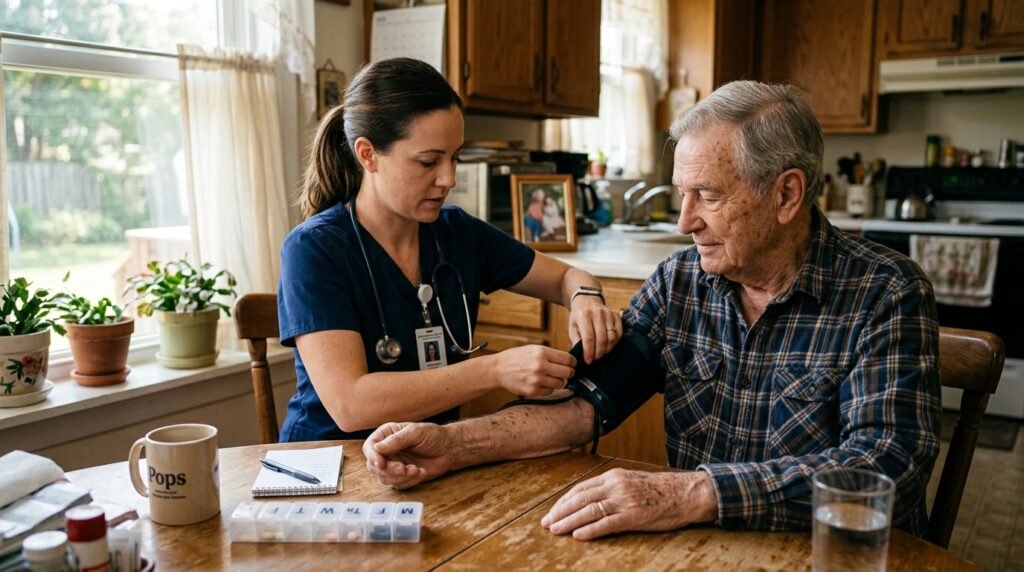
Your dad just got home from the hospital in Palos Heights after a heart failure flare-up. The discharge papers list six medications, a “watch your weight” warning, and a follow-up appointment three weeks out, and suddenly you’re the one expected to catch the next problem before it lands him back in the ER.
That’s exactly the gap home health fills. Home health care for congestive heart failure brings a skilled nurse into the home to monitor symptoms, manage medications, and teach families what to watch for, so small changes get caught early instead of becoming emergencies. For CHF patients across Chicago and the surrounding Illinois suburbs, it’s often the difference between staying stable at home and cycling back through the hospital.
Key Takeaways
- Home health care for CHF means in-home skilled nursing that tracks weight, blood pressure, and symptoms to catch fluid buildup early.
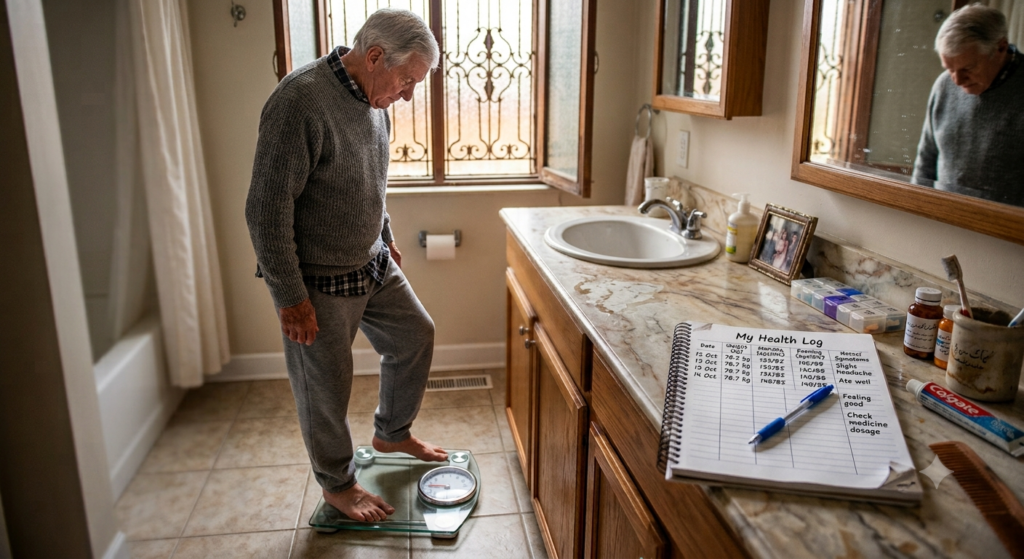
- Daily weight monitoring is the single most important habit. A 2–3 lb gain overnight can signal worsening heart failure.
- Medication management keeps diuretics, beta-blockers, and other heart drugs on schedule and safe.
- For eligible patients, Medicare typically covers home health for heart failure at $0 when a doctor orders it.
- The goal is fewer hospital readmissions and more independence at home.
What is congestive heart failure, and why does home care matter?
Congestive heart failure (CHF) is a chronic condition in which the heart can’t pump blood efficiently, so fluid backs up in the lungs, legs, and abdomen. It doesn’t mean the heart has “stopped.” It means it needs daily, careful management to keep that fluid under control.
That daily part is the problem. According to the Centers for Disease Control and Prevention, about 6.7 million U.S. adults are living with heart failure, and it’s one of the most common reasons older adults are readmitted to the hospital. Medicare even tracks heart failure readmissions closely through its Hospital Readmissions Reduction Program. Most of those return trips start small: a few pounds of fluid, a missed diuretic dose, swelling that no one flagged in time.
Home health care puts a trained set of eyes on those early signals, right where the patient lives.
How does home health care help manage congestive heart failure?
A Medicare-certified home health team turns “watch your symptoms” into an actual, structured plan. Here’s what that looks like in practice:
- Skilled nursing visits to check vital signs, listen to the lungs, and assess swelling (edema, meaning fluid buildup in the tissues).
- Medication management to make sure diuretics (water pills), beta-blockers, and blood-pressure medications are taken correctly and don’t interact dangerously.
- Symptom and weight monitoring, the cornerstone of CHF care, so sudden fluid gain is caught in a day, not a week.
- Patient and caregiver education on a low-sodium diet, fluid limits, and the warning signs that mean “call now.”
- In-home physical therapy to rebuild strength safely without overtaxing the heart.
- Home health aide support with bathing, dressing, and daily activities when fatigue makes them hard.
Much of this is delivered through intermittent skilled nursing, which means short, regular visits rather than round-the-clock care. It’s what Medicare’s home health benefit is designed to cover.
The daily CHF monitoring routine at home
Managing heart failure at home comes down to a simple, repeatable routine. A home health nurse sets it up and coaches the patient and family until it’s second nature:
- Weigh in every morning at the same time, on the same scale, after using the bathroom and before breakfast. Log the number.
- Check for swelling in the ankles, feet, and belly.
- Note new symptoms like shortness of breath, a nagging cough, or unusual fatigue.
- Take medications exactly as scheduled, using a pill organizer if needed.
- Follow the sodium and fluid plan the care team set.
- Call the nurse if any warning sign crosses the threshold below.
When to call: CHF warning signs
| Warning sign | What it may mean | Action |
| Weight up 2–3 lbs overnight or 5 lbs in a week | Fluid retention worsening | Call the home health nurse today |
| New or worse shortness of breath | Fluid in the lungs | Call the nurse; if severe, call 911 |
| Swelling in legs, ankles, or abdomen | Fluid buildup | Report at the next visit or sooner |
| Dizziness or confusion | Low output or medication effect | Call the nurse promptly |
| Chest pain, fainting, or gasping for air | Possible emergency | Call 911 |
This table is educational and doesn’t replace your care team’s instructions.
Worried about a recent CHF diagnosis or a hospital discharge? Choice Care Home Health can set up skilled nursing at home, often within days. Call (708) 489-0123 to talk through a plan for your loved one.
Does Medicare cover home health for heart failure?
For most CHF patients, yes. If a doctor certifies that the patient is homebound and needs skilled care, Medicare’s home health benefit typically covers it at $0 out of pocket. You can read the specifics on our guide to Medicare home health coverage in Illinois and our breakdown of what Medicare covers for home health care.
Not on traditional Medicare? Many Medicare Advantage and private plans cover home health too. See the insurance plans we accept. And if you’re comparing options, the official Medicare home health services page explains eligibility in plain terms.
One common mix-up worth clearing up: home health for CHF is medical care (skilled nursing and therapy ordered by a physician), not the same as non-medical companion care. That medical piece is what makes it Medicare-eligible.
Who provides the care, and where
Choice Care Home Health is a Medicare-certified, ACHC-accredited agency, and heart failure care is delivered by a coordinated team: skilled nurses for monitoring and medications, therapists for safe cardiac rehabilitation and conditioning, and home health aides for daily support. A medical social worker can help connect families to community resources when needed.
We serve Chicago and the southwest suburbs, including Palos Heights, Palos Hills, and Orland Park, along with Cook, DuPage, and Will Counties, Illinois. That local footprint matters: a nearby team can respond quickly when a patient’s weight spikes or symptoms change.
For discharge planners and case managers: we accept referrals for CHF patients transitioning home and can coordinate a start-of-care visit fast to help reduce 30-day readmissions. Call (708) 489-0123 or contact our intake team to arrange a referral.
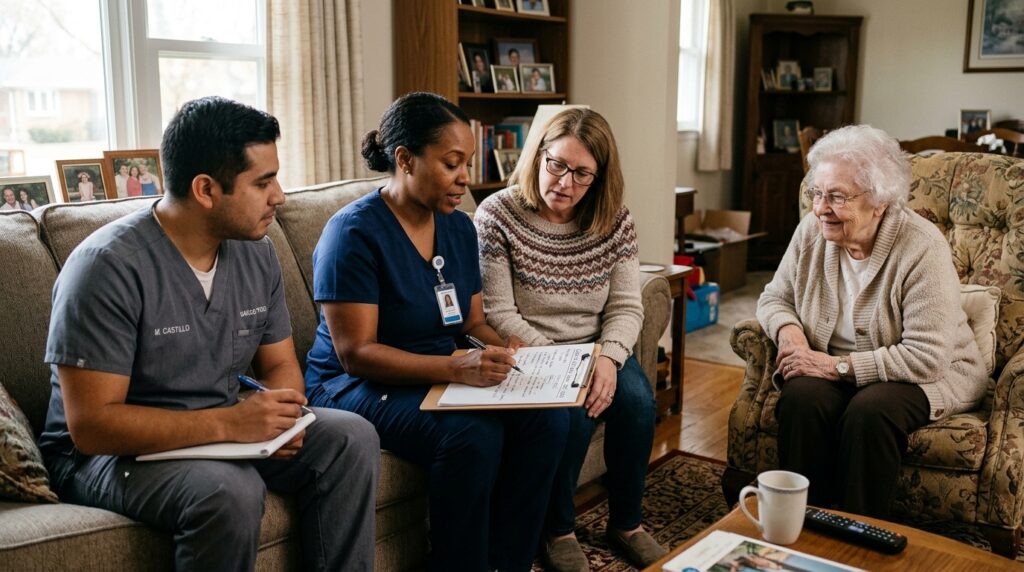
For families: you don’t have to manage heart failure alone. Choice Care can build a home care plan around your loved one’s diagnosis, insurance, and daily needs. Reach us at (708) 489-0123 or explore our full home health services to get started.
FAQ Section
How does home health care help with congestive heart failure?
Home health care helps CHF patients by sending a skilled nurse to the home to monitor weight and blood pressure, manage heart medications, watch for fluid buildup, and teach families warning signs. This early monitoring catches problems before they become emergencies, which helps many patients avoid repeat hospital stays and stay independent at home longer.
Does Medicare cover home health care for heart failure?
Yes, in most cases. If a physician certifies that a heart failure patient is homebound and needs skilled nursing or therapy, Medicare’s home health benefit typically covers the care at $0 out of pocket. Many Medicare Advantage and private insurance plans also cover home health, though specific eligibility and visit limits vary by plan.
How often should a CHF patient weigh themselves?
Every single morning, at the same time, on the same scale, after using the bathroom and before eating. Daily weight is the earliest clue to fluid retention. A gain of 2–3 pounds overnight or about 5 pounds in a week should prompt a call to the home health nurse, because it often signals worsening heart failure
What are the warning signs that heart failure is getting worse?
Key warning signs include sudden weight gain, increased shortness of breath, swelling in the legs, ankles, or abdomen, a persistent cough, unusual fatigue, or dizziness. Severe breathlessness, chest pain, or fainting are emergencies, so call 911. Milder changes should be reported to the home health team promptly so medications can be adjusted.
How soon can home health care start after a hospital discharge?
Often within a day or two. Once a doctor orders home health and the referral reaches the agency, an intake nurse schedules a start-of-care visit. Fast starts matter most in the first weeks after a heart failure hospitalization, when the risk of readmission is highest, so timely setup is a priority.
Is home health care the same as a home health aide or companion care?
No. Home health care for CHF is medical care, meaning skilled nursing and therapy ordered by a physician. A home health aide provides personal-care support like bathing and dressing, and companion care is non-medical. Heart failure patients often receive a blend, but the skilled medical piece is what makes the service Medicare-eligible.
Which areas near Chicago does Choice Care serve for CHF home health?
Choice Care Home Health serves Chicago and the southwest suburbs, including Palos Heights, Palos Hills, and Orland Park, across Cook, DuPage, and Will Counties, Illinois. A local team can respond quickly to symptom changes, which is important for managing a fluid-sensitive condition like congestive heart failure.