
Introduction
When someone you love or you yourself is dealing with nerve damage, the questions start piling up fast.
Can I get feeling back? Will my hand work again? Is this just permanent?
These are questions I hear all the time. And honestly, they are not easy to answer because nerve damage is different for every person.
What I can tell you from years of working with patients is this: OT help with nerve damage is real. It is not a miracle cure. But it is often the difference between giving up on a task forever and slowly, carefully getting it back.
So let me walk you through what nerve damage actually looks like, what therapy can do, and what to realistically expect.
What Is Nerve Damage, Really?
Your nervous system is like a massive communication network. It sends signals from your brain to your muscles, your skin, your fingers, your feet everywhere.
When something damages those nerves whether it is an injury, a stroke, diabetes, or surgery those signals get disrupted. Sometimes they slow down. Sometimes they stop completely.
Patients describe it in different ways.
Some say their hand feels like it is wearing a thick glove, they can touch things but cannot feel them properly. Others describe burning, tingling, or sharp electric sensations that come out of nowhere. And some people lose strength in a limb, their grip just is not there anymore.
Common causes I see in my work include:
- Diabetic neuropathy (gradual nerve damage from high blood sugar)
- Stroke (brain injury that interrupts nerve signaling)
- Physical injuries (car accidents, falls, cuts, fractures)
- Post surgical nerve trauma
- Carpal tunnel syndrome and nerve compression
Each one affects the body differently. And recovery when it happens looks different too.
So, Can Occupational Therapy Actually Help?
Short answer: yes. But with honest expectations.
OT help with nerve damage is not about forcing nerves to regenerate overnight. Nerves heal slowly some faster than others and no therapist can speed that process up beyond what biology allows.
What occupational therapy does is work alongside that biological healing. We focus on function meaning, what can you actually do today, and how do we make that better?
I have worked with patients who came in unable to button their shirt, open a jar, or write their own name. After consistent therapy, some of them got those skills back. Others learned new ways to do those same tasks. Both outcomes matter.
The severity of the nerve damage matters a lot. Partial nerve damage tends to respond better to therapy than complete nerve injury. But even with severe damage, adaptive strategies can restore a lot of independence.
How Occupational Therapy Actually Helps
When a patient comes to me with nerve damage, I am not just thinking about the nerve. I am thinking about their whole day.
Can they get dressed? Feed themselves? Hold a phone? Pick up their grandchild?
That is what occupational therapy services are built around getting people back to their daily life, whether that means relearning old abilities or finding smarter ways to manage.
Here are some of the things we work on:
Sensory retraining. When nerve signals are disrupted, the brain sometimes needs to relearn how to interpret what it feels. We use textures, temperatures, and touch exercises to help rebuild that connection.
Strengthening weak muscles. Nerves that are partially damaged can often be supported by strengthening the muscles around them. Gentle resistance exercises help maintain function while healing continues.
Improving coordination. Fine motor tasks picking up small objects, writing, fastening buttons require precise nerve muscle coordination. We practice these slowly and deliberately.
Adaptive equipment. Sometimes the nerve damage is significant enough that we need to adapt to the task itself. Built up handles, button hooks, grab bars these tools keep people independent without waiting for full recovery.
Pain management strategies. Nerve pain is real and it is exhausting. Part of our work involves teaching patients how to manage flare ups, reduce aggravation, and protect sensitive areas during daily tasks.
Adult occupational therapy services are specifically designed to meet patients where they are in life not just physically, but in terms of what matters to them.
Therapy Looks Different for Different Patients
Nerve damage does not discriminate. I have worked with 30 year olds recovering from a workplace injury and 80 year olds managing stroke related weakness. Children get nerve damage too sometimes from birth trauma, sometimes from accidents.
For adults and seniors, the goals are usually around independence, getting back to cooking, bathing, driving, or returning to work. For older patients, fall prevention and safe movement around the home become especially important.
For children, therapy looks completely different. Occupational therapy services for children are play based and developmental. When a child has nerve damage from birth, injury, or a medical condition we focus on how they interact with their world.
Early childhood occupational therapy services for children birth to five can be especially powerful. The brain is still developing during those early years, and nerve pathways have more flexibility to adapt. We use sensory play, movement, and fine motor activities in ways that feel completely natural to the child.
Occupational therapy services for kids in middle school look different again, more focused on school tasks, writing, using technology, and navigating social environments. Occupational therapy services for middle school kids often address how nerve damage affects learning and daily school routines.
What a Typical Therapy Session Looks Like
A lot of patients come in expecting something intense like physical training. The reality is usually quieter than that.
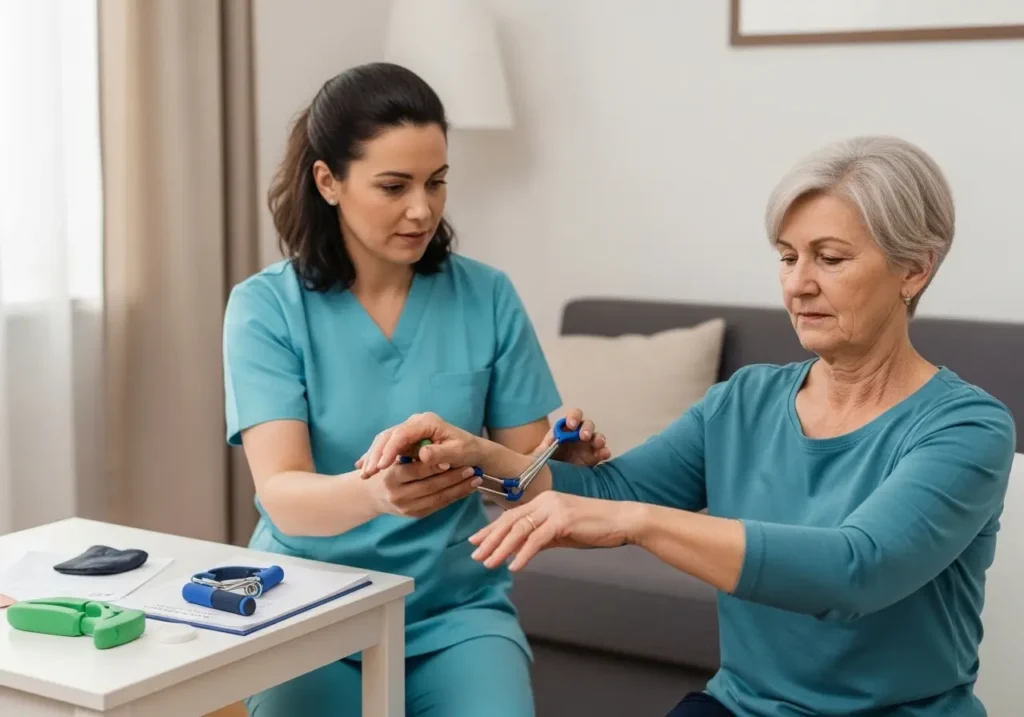
We might spend time picking up coins from a flat surface to retrain fine motor control. We practice pinching, gripping, and releasing objects of different sizes and textures.
Sometimes we practice a daily task directly like putting on a sock, opening a medicine bottle, or using a fork. The goal is always real life, not just therapy exercises.
Heat, cold, and vibration tools are often used to stimulate nerve pathways. We might also use electrical stimulation to help signal weakened muscles.
Sessions usually run 45 to 60 minutes, and most patients benefit from two to three sessions per week especially in the early stages of recovery.
It is not dramatic. But the small gains add up. I have seen patients cry when they finally button a shirt again after three months of practice. That moment is real.
Therapy at Home Yes, It Is an Option
One of the most common barriers I hear is transportation. Getting to a clinic twice a week is genuinely difficult for many people, especially seniors, people with limited mobility, or caregivers managing a full schedule.
That is where in home occupational therapy services make a real difference.
There is something valuable about working with patients in their actual environment. I can see the specific stairs they climb every morning, the bathroom layout they navigate, the kitchen setup they work with. Therapy recommendations become far more practical.
Online occupational therapy services have also expanded significantly. For patients who are medically stable and have good support at home, virtual sessions allow for consistent check-ins, guided home exercise programs, and real time coaching without requiring travel.
Neither option is perfect for every situation. But they mean that geography or mobility should not be the reason someone misses out on care.
Home Health Care and Therapy How They Work Together
For patients with nerve damage who are recovering at home, occupational therapy rarely works alone.
Skilled nursing care at home often runs alongside OT. Nurses monitor medications, manage wound care, track vital signs, and communicate changes to the therapy team. When a patient’s condition shifts to a new symptom, a fall, increased pain the care team can respond quickly.
Caregivers who work closely with patients every day become an important part of the recovery process too. When a caregiver understands the therapy goals, they can reinforce exercises and safe habits between therapy sessions.
Coordinated home health care services in Chicago and the surrounding area have grown significantly, making it easier for families to access multiple types of support without disrupting a patient’s life at home.
If you are looking for the best home health care services in Illinois, ask specifically whether the agency coordinates occupational therapy with nursing and personal care. That kind of coordinated approach gets better outcomes.
Local Support in the Chicago and Orland Park Area
Families across the south and southwest suburbs of Chicago often ask me where to find reliable support for an aging parent or a recovering family member.
Home health care for seniors in Chicago and the surrounding communities has become more accessible. Whether someone is in Orland Park, Lemont, Naperville, or closer to the city, home health care Orland Park IL and nearby areas offer skilled nursing, therapy, and personal care under one coordinated plan.
For families managing nerve damage recovery alongside other health conditions, home help for seniors in Chicago means care can come to the patient rather than exhausting an already tired family getting someone to multiple appointments.
Senior care in Chicago continues to evolve, with more options available for older adults who want to stay at home while still receiving professional therapy and nursing support. Older health care services in Chicago now include dedicated rehab programs that run entirely in the patient’s home.
Does Medicare Cover Home Based Occupational Therapy?
This comes up in almost every family conversation. Does Medicare pay for home health care for seniors including occupational therapy?
The answer is yes, under specific conditions.
Medicare Part A and Part B both cover home health services when the patient is considered homebound and a doctor certifies that skilled care is medically necessary. Occupational therapy is listed as a covered skilled service when it is part of a broader home health plan.
The agency providing care must be Medicare certified, and the services must be ordered and reviewed by a physician. For patients recovering from stroke, nerve injury, or surgery, these requirements are typically easy to meet.
Ask your care provider specifically about Medicare eligibility when you call to set up services.
How Long Does Recovery Actually Take?
I wish I had a clean answer for this. I do not.
Nerve recovery can be slow. Sometimes frustratingly slow. Nerves regrow at a rate of about one inch per month and some injuries require them to regrow several inches before function returns.
Recovery also depends on:
- The type and severity of the nerve damage
- How quickly treatment started after the injury
- The patient’s age and overall health
- Consistency with therapy and home exercises
- Whether the underlying cause (like diabetes) is being managed
Some patients see meaningful improvement in three to six months. Others work for a year or more before reaching a plateau and then continue making smaller gains beyond that.
I have seen small improvements make a big difference over time. A patient who could not hold a spoon eventually learned to eat independently again. It took eight months. That is not a failure. That is a win.
Common Mistakes That Slow Recovery
This is something many patients ask about and it matters more than people realize.
Expecting quick results. When progress stalls after a few weeks, some patients stop coming. But that early plateau is often right before the next breakthrough. Consistency through the slow periods is where recovery actually happens.
Skipping home exercises. Therapy sessions alone are not enough. The work done at home between appointments is where the nervous system actually adapts. Skipping it slows everything down.
Avoiding the affected limb. It is natural to protect a weak or numb arm or leg. But avoiding it entirely leads to what therapists call learned non use the brain stops trying to communicate with that limb. Using it carefully and with guidance keeps those neural pathways active.
Waiting too long to start. Earlier intervention consistently leads to better outcomes. The nervous system is most adaptable in the early weeks after injury. Delays can mean missing a critical window.
Common Questions About OT and Nerve Damage
Can nerves fully heal after damage?
Sometimes, yes. Mild to moderate nerve damage especially from compression injuries or certain surgeries can fully recover with time and therapy. Severe nerve injuries often result in partial recovery. The goal is always to maximize what is possible.
How long does occupational therapy for nerve damage take?
It varies widely. Some patients reach their goals in three to four months. Others continue therapy for a year or more, especially when managing ongoing conditions like diabetic neuropathy or post stroke recovery.
Is home therapy as effective as clinic based therapy?
For many patients, yes. In-home occupational therapy services allow therapists to work directly in the patient’s living environment which often leads to more practical, relevant recommendations. Online therapy can also be highly effective for patients who are motivated and have a caregiver to assist.
When should therapy start after nerve damage?
As soon as medically appropriate. For some injuries, that is within days. For surgical cases, it may be a few weeks after the procedure. The sooner therapy begins, the better the outcomes tend to be.
Is OT help with nerve damage covered by insurance?
Medicare, Medicaid, and most private insurers cover occupational therapy when it is medically necessary. Home health therapy services are also often covered under Medicare Part A and Part B for homebound patients. Always verify with your specific provider.
Can children with nerve damage benefit from OT?
Absolutely. Children often show remarkable recovery especially when therapy starts early. Play based sessions, sensory activities, and developmental exercises make a significant difference for kids recovering from nerve injuries or managing conditions like cerebral palsy or brachial plexus injuries.
A Final Word Progress Takes Time, But It Is Possible
It does not always go perfectly. There are frustrating weeks, discouraging plateaus, and moments where progress feels invisible.
But I have watched enough recoveries to know this: the patients who stay consistent, who show up even on the hard days, and who accept small wins are the ones who get the best outcomes.
If you are in the Chicago area and trying to figure out next steps for yourself or someone you care about, know that support exists. Whether you are looking into senior home care in Chicago, home health care in Chicago Illinois, or simply want to know your options for therapy help is closer than you think.
Nerve recovery is slow. Sometimes frustrating. But progress is possible.
And a good therapist and the right support team can make all the difference. Read more