

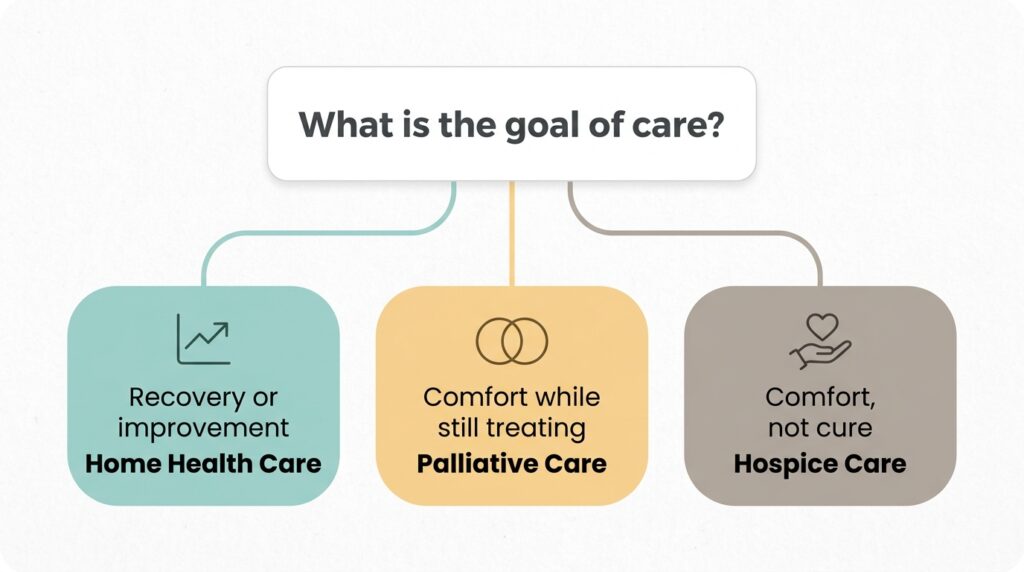
The real difference between home health care and hospice care comes down to the goal: home health helps a person recover, with skilled nursing and therapy ordered by a doctor to treat and improve a condition, while hospice cares for a person who is no longer pursuing a cure, focusing entirely on comfort, dignity, and quality of life in their final months. Families across Chicago and the southwest suburbs face this exact choice every week, often in a hospital hallway with little explanation. This page gives you the full answer, starting with the side-by-side comparison.
Home Health Care vs. Hospice Care: What’s Different at a Glance?
| Home Health Care | Hospice Care | |
| Goal | Recovery, improvement, or maintaining function | Comfort and quality of life, not cure |
| Who qualifies | Doctor-certified skilled need; patient is homebound | Life expectancy of 6 months or less; comfort care elected |
| Typical services | Skilled nursing, PT/OT/speech therapy, home health aide, medical social work | Pain and symptom management, nursing, aide, chaplain, family, and grief support |
| Duration | Weeks to a few months, tied to recovery goals | As long as needed; recertified past 6 months |
| Homebound required | Yes, under Medicare | No |
| Medicare coverage | 100% of eligible visits under the home health benefit | Nearly all costs under the hospice benefit, including related medications |
| Can it end? | Yes, when goals are met | Yes, patients can revoke or graduate if they improve |
Everything below unpacks this table, one question at a time.
What Is Home Health Care?
Home health care brings medical treatment into the house under a doctor’s plan of care. Its goal is improvement: recovering after surgery or a hospital stay, regaining strength after a stroke or fall, or keeping a chronic condition like heart failure, COPD (chronic obstructive pulmonary disease, a progressive lung condition), or diabetes stable enough to stay out of the hospital.
A typical plan combines intermittent skilled nursing, meaning scheduled nurse visits for wound care, medication management, and monitoring, with physical therapy, occupational therapy, or speech therapy as ordered. A home health aide may assist with bathing and daily activities as part of the medical plan, and a medical social worker helps with resources and planning. You can see the full range of home health services an agency typically provides.
To qualify under Medicare, a physician must certify the need for skilled care, and the patient must be homebound, meaning leaving home takes considerable effort. Care is intermittent, usually a few visits a week for weeks or a few months.
What Is Hospice Care?
Hospice is for a different season. When an illness can no longer be cured, or when treatment costs more in suffering than it gives back in time, hospice shifts every effort toward comfort. That includes pain and symptom management, nursing visits, aide support, spiritual care through a chaplain if wanted, and counseling for the family, including bereavement support after a loss.
To elect the Medicare hospice benefit, a physician certifies a life expectancy of six months or less if the illness runs its natural course, and the patient chooses comfort care instead of curative treatment for that illness. Nobody has to be homebound, and hospice isn’t limited to cancer; families in the Chicago area use it for advanced dementia, heart failure, lung disease, and kidney disease. Hospice is used far more than most families realize: roughly half of Medicare beneficiaries who die each year are enrolled in hospice at the time of death, according to the Medicare Payment Advisory Commission (MedPAC).
Two things hospice is not: it isn’t “giving up,” and it isn’t permanent. Patients can leave hospice at any time if they improve or choose to resume treatment.
What About Palliative Care, the Option in Between?
Many families choosing between the two actually need the third option nobody explained. Palliative care is specialized comfort and symptom support for anyone with a serious illness, at any stage, while still receiving curative treatment. Someone getting chemotherapy can have palliative support for pain and nausea. There’s no six-month requirement and no choice to give anything up.
Think of it as a spectrum: home health treats and rehabilitates, palliative care adds comfort alongside treatment, and hospice provides full comfort care when treatment stops. If you’re unsure where your loved one falls, that’s a conversation worth having with their doctor, and a medical social worker can help your family sort through the options and connect with the right programs.
Trying to figure out which care fits a parent in the Palos Heights or greater Chicago area? Choice Care Home Health provides Medicare-certified home health across Cook, DuPage, and Will counties, and if hospice is the better fit, we’ll tell you honestly and help you find it. Call (708) 489-0123 for a straightforward conversation.
How Do You Know Which One Your Loved One Needs?
- Start with the goal. Ask the doctor: “Is the aim to treat and improve this condition, or to keep her comfortable?” That single question usually points to the answer.
- Ask about the trajectory. If the doctor wouldn’t be surprised by continued decline over the next six months despite treatment, ask whether a hospice evaluation makes sense.
- Weigh what the treatment costs the patient. Hospitalizations, side effects, and exhausting appointments may be worth it, or may not be. The patient’s own wishes lead here.
- Request an evaluation, not a commitment. Both home health agencies and hospice programs assess eligibility for free. An assessment is information, not a decision.
- Revisit as things change. Many patients use home health first, then transition to hospice later. Choosing one today doesn’t close the other door.

Does Medicare Cover Home Health or Hospice?
This is the worry families voice last but feel first, and the news is better than most expect. When eligibility rules are met, Original Medicare pays 100% of the cost of covered home health visits, with no deductible or copay. The hospice benefit is broader still: it covers the care team, medical equipment, and medications related to the terminal illness, with little to no out-of-pocket cost. Details for both benefits are on Medicare.gov. Medicare Advantage and Medicaid plans cover both as well, sometimes with their own rules, so have the provider verify your insurance in writing before care starts. One rule to know: a patient can’t receive home health and hospice for the same condition at the same time; if hospice is elected, it takes over care for that illness.
If ongoing help at home is what’s really needed, our guide to getting a home health aide through Medicare walks through those rules.
Key Takeaways
- Home health care is treatment-focused: nursing and therapy visits aimed at recovery or maintaining function, ordered by a physician.
- Hospice care is comfort-focused: for patients with a life expectancy of six months or less who choose to stop curative treatment.
- Medicare covers both benefits, under different rules; home health requires being homebound, hospice does not.
- A person can move from home health to hospice, or leave hospice if their condition improves; the choice is never locked.
- Palliative care is the middle path many families don’t know exists: comfort support alongside ongoing treatment.
The Kindest Choice Is an Informed One
Neither option is a surrender, and neither is a miracle; they’re tools for different goals. Name the goal honestly, with the doctor and with each other, and the right choice usually names itself.
If recovery or stability at home is the goal, Choice Care Home Health has served Palos Heights, Chicago, and the southwest suburbs since 2001 as a Medicare-certified, ACHC-accredited agency. Call (708) 489-0123 or reach us online, and we’ll help you think it through, whichever direction is right.
For discharge planners, case managers, and physicians: we respond to home health referrals the same day across Cook, DuPage, and Will counties, and coordinate transitions when a patient moves between home health and hospice. Fax orders to (708) 489-2399 or call (708) 489-0123.
Section
Can you have home health care and hospice at the same time?
Not for the same illness. When a patient elects the Medicare hospice benefit, hospice takes over all care related to the terminal condition, so home health for that condition ends. A patient can, in limited cases, receive home health for a separate, unrelated condition. In practice, most families transition fully from home health to hospice when the goal shifts from treatment to comfort.
Does hospice mean giving up on treatment?
No. Hospice means shifting the goal of treatment from curing the illness to controlling pain and symptoms so the person can live as fully as possible. Patients still receive active medical care, including medications, nursing, and equipment. And the choice is reversible: a patient can leave hospice at any time to resume curative treatment, or stay beyond six months if a doctor recertifies eligibility.
Who qualifies for hospice care under Medicare?
A patient qualifies when a hospice doctor and their own physician certify a life expectancy of six months or less if the illness follows its natural course, and the patient chooses comfort care in place of curative treatment. The patient does not need to be homebound. Qualifying conditions go beyond cancer to advanced dementia, heart failure, COPD, and kidney disease.
Is home health care covered 100% by Medicare?
Yes, when eligibility is met. If a doctor certifies the need for skilled care and the patient is homebound, Original Medicare covers eligible home health visits in full, with no deductible or copay. Non-medical help alone, like housekeeping or companionship without a skilled need, isn’t covered, which is a common point of confusion for families.
What is the difference between palliative care and hospice?
Palliative care provides comfort and symptom relief at any stage of a serious illness, alongside curative treatment; hospice provides comfort care only for patients with a prognosis of six months or less who stop curative treatment. All hospice includes palliative care, but palliative care isn’t hospice. Ask the doctor for a palliative consult if your loved one needs relief but isn’t ready to stop treating the illness.
How long can someone stay on hospice care?
As long as they remain eligible. The Medicare hospice benefit starts with two 90-day periods, followed by unlimited 60-day periods, each requiring a doctor to recertify that life expectancy remains six months or less. Some patients receive hospice for well over a year, and some improve enough to be discharged. The six-month rule is an entry criterion, not a time limit.