
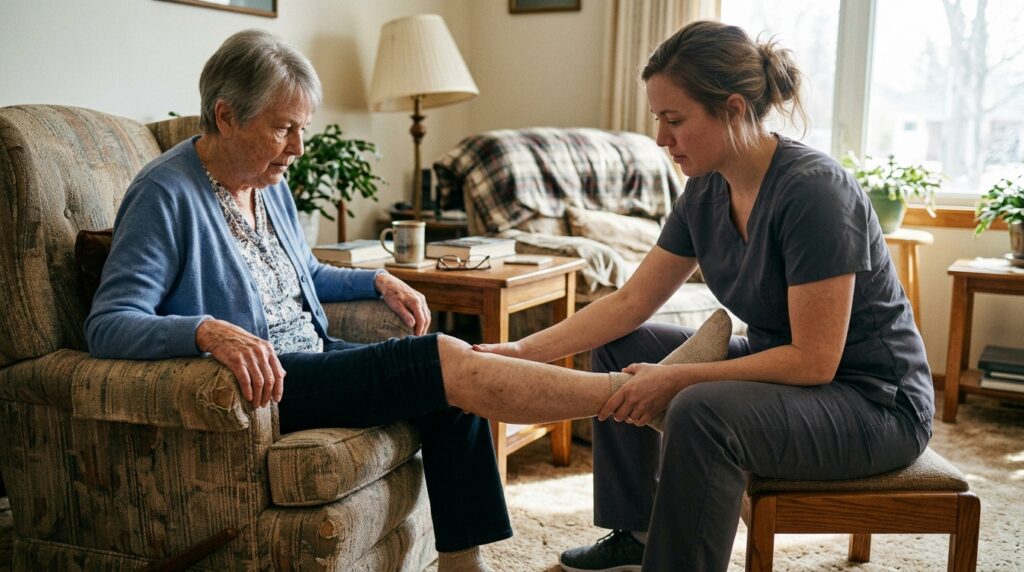
Your father sits on the edge of his bed in his Orland Park, IL home for a full five minutes most mornings before he tries to stand. His knees don’t want to cooperate until they’ve “warmed up,” as he puts it, and the jar of instant coffee he’s opened every morning for thirty years has started fighting back too. He hasn’t fallen. He hasn’t asked for help. But you’ve noticed, and you’re starting to wonder what actually helps.
Home health care for arthritis and joint pain brings physical therapy, occupational therapy, and skilled nursing into the home to reduce pain, protect joints, and help patients keep doing daily tasks safely, without necessarily needing to leave the house for appointments. In the Chicago area, including Orland Park, Palos Heights, and Palos Hills, Medicare-certified agencies can build a plan of care around a patient’s specific joints, symptoms, and home layout.
In plain terms: Home health care for arthritis and joint pain is in-home therapy and nursing support that helps patients manage stiffness and pain, protect their joints during daily activities, and stay mobile and independent without unnecessary trips out of the house.
Key Takeaways
- Arthritis (inflammation of the joints that causes pain and stiffness) affects roughly 1 in 5 U.S. adults, according to the CDC
- Home health care typically combines physical therapy, occupational therapy, and, when needed, skilled nursing and a home health aide.
- Therapy focuses on joint protection, pain management, and adapting daily tasks, not just exercise.
- Cold, damp weather, common during Chicago winters, often makes arthritis stiffness worse, which is one reason in-home care matters here.
- Medicare typically covers home health care for arthritis when a physician certifies it’s medically necessary.
How Arthritis and Joint Pain Affect Daily Life at Home
Arthritis rarely announces itself all at once. It shows up in small daily struggles that add up, and those small struggles matter more than they might seem. A parent who quietly stops climbing the basement stairs, or starts skipping showers because getting in and out of the tub hurts, is often losing independence gradually enough that no single moment feels like the right one to ask for help.
Left unaddressed, that same stiffness and pain also raises fall risk, since a joint that hurts often gets favored or avoided rather than strengthened, which can quietly weaken balance over time.
| Daily Task | Common Arthritis Challenge | How Home Health Care Helps |
| Getting out of bed | Morning stiffness, slow to loosen up | PT teaches gentle warm-up stretches and safe transfer techniques |
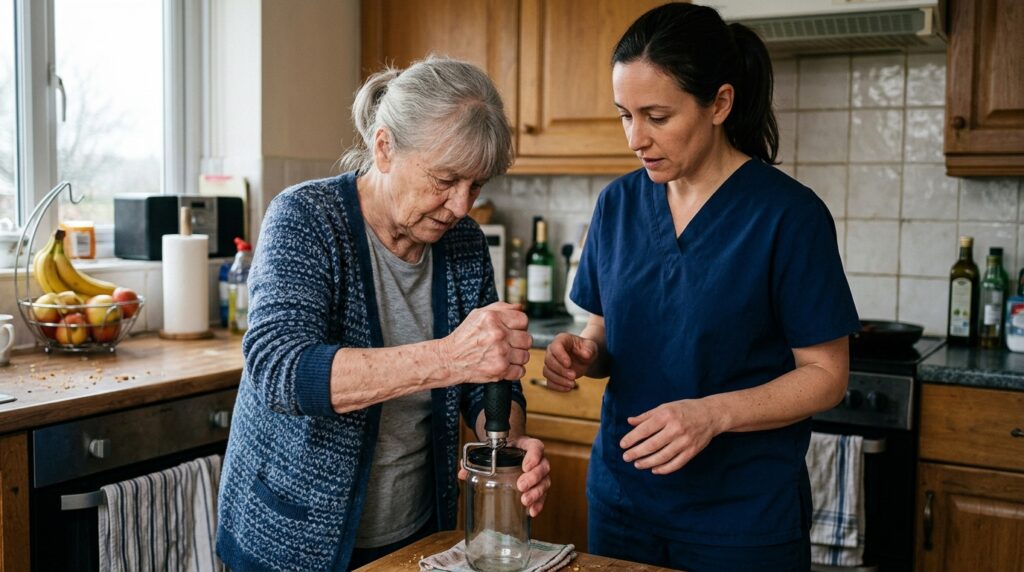
| Opening jars or using kitchen tools | Reduced grip strength in fingers and hands | OT introduces adaptive tools and joint protection techniques |
| Climbing stairs | Knee or hip pain, fear of falling | PT builds strength and balance, recommends safe stair habits |
| Getting dressed | Limited shoulder or hand mobility | OT teaches energy-saving dressing techniques and adaptive clothing options |
| Standing for meal prep | Fatigue and joint pain from prolonged standing | OT suggests seated prep stations and pacing strategies |
| Managing pain medication | Multiple medications, timing confusion | Skilled nursing reviews the medication schedule and monitors side effects |
What Does Home Health Care for Arthritis Look Like?
A typical plan of care draws from a few core services, matched to what a patient actually struggles with.
Physical therapy focuses on strengthening the muscles around affected joints, improving balance, and reducing fall risk, all at a pace the joints can tolerate. Learn more about our physical therapy services.
Occupational therapy addresses the practical side: how to get dressed, cook, and manage the house without straining already inflamed joints. Our occupational therapy team also introduces adaptive equipment, like built-up utensil handles or long-handled reachers, when they genuinely help.
Skilled nursing steps in when arthritis is part of a bigger picture, managing pain medications, monitoring for side effects, or coordinating care alongside other conditions like diabetes or CHF (congestive heart failure). See our skilled nursing care page for details.
Home health aide services provide hands-on help with bathing, dressing, and light housekeeping on days when joint pain makes those tasks genuinely hard. Explore our home health aide services.
A Sample Daily Routine for Staying Mobile with Arthritis
Most therapists build a routine around three simple principles: move gently, protect the joint, and pace the day.
- Morning: Gentle stretching before getting out of bed, followed by a warm shower to loosen stiff joints before starting the day.
- Midday: A short walk or seated exercise session, timed for whenever pain and stiffness are typically lowest.
- Meal prep: Sitting whenever possible, using adaptive tools for chopping or opening containers, and taking breaks between steps.
- Afternoon: A rest period to avoid overdoing it, since pushing through fatigue often makes evening pain worse.
- Evening: A brief stretching or range-of-motion routine before bed, and ice or heat as recommended by the care team.
This isn’t a rigid schedule. It’s a framework a home health therapist adjusts based on which joints are affected and how the patient actually feels day to day.

Managing Arthritis Pain Without Overdoing It
It’s tempting to either push through pain or avoid movement entirely, and both tend to backfire. Home health therapists generally coach patients toward the middle ground: enough movement to keep joints from stiffening further, without straining them.
That balance looks different for osteoarthritis (wear-and-tear joint damage, the most common form of arthritis) than it does for rheumatoid arthritis (an autoimmune condition that causes joint inflammation), which is one reason a personalized plan of care matters more than generic advice found online. Someone managing rheumatoid arthritis may need to adjust activity around flare-ups, while someone with osteoarthritis in a single knee or hip often benefits most from steady, gradual strengthening around that joint. A home health therapist builds the plan around the specific diagnosis, not a one-size-fits-all worksheet.
Not sure whether therapy or a home health aide would help more? Call Choice Care Home Health at (708) 489-0123. We can talk through your specific situation and help you figure out the right mix of services.
Will Insurance Cover Home Health Care for Arthritis?
Left unaddressed, that same stiffness and pain also raises fall risk, since a joint that hurts often gets favored or avoided rather than strengthened, which can quietly weaken balance over time. The CDC reports that more than 14 million older adults, about 1 in 4, fall each year. Medicare.gov confirms that “a health care provider must order your care, and a Medicare-certified home health agency must provide it.” Our insurance plans page lists what else we accept. If arthritis pain is limiting how far or how safely someone can travel to outpatient appointments, that’s often enough to qualify for in-home therapy instead.
Medical Therapy vs. Non-Medical Help for Arthritis at Home
Families often need both. Physical and occupational therapy are medical services requiring a physician’s order, focused on improving strength, mobility, and joint protection. A home health aide provides non-medical, hands-on personal care, like help bathing on a high-pain day. A home health agency coordinates both under one plan of care, so you’re not managing two separate arrangements.
How Fast Can Care Start?
Once we receive a physician’s order, we can typically schedule an initial evaluation within a day or two. This applies whether the referral comes after a joint replacement surgery, a new arthritis diagnosis, or simply because mobility has quietly gotten harder over the past few months.
For Discharge Planners and Case Managers
If you’re coordinating care after a joint replacement or managing a patient with worsening arthritis-related mobility loss, Choice Care Home Health accepts referrals from Chicago-area hospitals and orthopedic offices across Cook, DuPage, and Will Counties. Post-surgical arthritis and joint replacement patients in particular tend to do better with therapy started promptly, before stiffness sets in during the first days home. We’re Medicare certified and ACHC accredited, and our intake team works directly with your discharge staff to keep the transition smooth. Reach our referral line at (708) 489-0123.
Getting Started
Chicago winters are hard enough on healthy joints, let alone ones already dealing with arthritis. If icy sidewalks, cold snaps, or simple stiffness are making it harder for your loved one to get around safely in Orland Park, Palos Heights, Palos Hills, or anywhere nearby, in-home therapy can meet them where they are.
Choice Care Home Health is Medicare certified and ACHC accredited, and our full range of home health services is built to help patients stay mobile and independent at home. Call us at (708) 489-0123, or reach out through our contact page, and we’ll help you figure out the right plan of care.
FAQ Section
Can home health care help with arthritis and joint pain?
Yes. Home health physical and occupational therapists can reduce pain, improve joint mobility, and teach safer ways to handle daily tasks like dressing, cooking, and climbing stairs. A physician’s order is needed to start these services under a home health plan of care.
What’s the difference between physical therapy and occupational therapy for arthritis?
Physical therapy focuses on strength, balance, and joint mobility through targeted exercise. Occupational therapy focuses on making daily tasks, like cooking, dressing, and bathing, easier and safer on the joints. Many arthritis patients benefit from both.
Does cold weather make arthritis worse?
Many people with arthritis report more stiffness and pain during cold, damp weather, which is common in Chicago winters. While the science isn’t fully settled on why, home health therapy can help patients adjust their routine and stay active safely through seasonal changes.
Will Medicare pay for home health therapy for arthritis?
Usually, yes. When a physician certifies that physical or occupational therapy is medically necessary and the patient meets homebound criteria, Original Medicare typically covers home health visits in full, generally with no copay.
Is home health care only for severe arthritis?
No. Home health care can help at any stage, whether someone is newly diagnosed and adjusting their routine, recovering from joint replacement surgery, or managing long-term stiffness that’s slowly limiting their independence.
Can a home health aide help someone with arthritis who doesn’t need therapy?
Yes. If a patient’s main need is hands-on help with bathing, dressing, or light housekeeping on high-pain days, rather than clinical therapy, a home health aide can provide that support as part of a broader plan of care.
How soon can arthritis-related home health care start?
Once a physician’s order is in place, an initial evaluation can usually be scheduled within a day or two. This applies to new diagnoses, post-surgical referrals, and situations where mobility has gradually declined over time.