

Intermittent Skilled Nursing: What It Is & Who Qualifies
Three days after her hip surgery, Carol is home in Palos Heights, and a nurse is standing in her kitchen checking the incision, reviewing her thinner blood dosage, and asking how the pain is at rest versus when she stands up. Carol’s daughter, watching from the doorway, asks the question a lot of families ask at this exact moment: “Wait, is this the same as the aide who’s coming Thursday to help her shower?”
It isn’t. Intermittent skilled nursing is medically necessary nursing care, including wound care, medication management, and monitoring a chronic condition, delivered part-time or on a set schedule by a registered nurse (RN) or licensed practical nurse (LPN), ordered by a physician. It’s “intermittent” because it isn’t 24-hour care; it’s scheduled visits, often a few times a week, that taper as the patient stabilizes. For families across Chicago, Palos Heights, and Cook, DuPage, and Will counties, understanding what this service actually includes and who qualifies is usually the first real decision point after a hospital stay or new diagnosis.
Key Takeaways
- Intermittent skilled nursing is part-time, physician-ordered nursing care (wound care, medication management, monitoring) delivered at home by an RN or LPN.
- It differs from a home health aide, who provides non-medical personal care like bathing and dressing, not clinical treatment.
- To qualify, a patient must be homebound, need skilled care certified by a doctor, and use a Medicare-certified agency.
- Medicare typically pays 100% of approved intermittent skilled nursing visits, with no homebound-related cost to the patient.
- Care usually lasts weeks to a few months, tied directly to the medical need; it isn’t designed to be permanent.
What Is Intermittent Skilled Nursing?
Intermittent skilled nursing is a category of home health care defined by Medicare and delivered by licensed nurses for patients who need clinical treatment they can’t safely manage on their own, but who don’t need to be in a hospital or nursing facility. “Skilled” means the task requires the training and judgment of a licensed nurse, such as IV therapy, injections, or reading and responding to changes in vital signs. “Intermittent” means the care is part-time and scheduled, not continuous around-the-clock supervision.
A physician has to order it, and it’s delivered under a formal plan of care that the nurse and doctor build together. This is different from ongoing custodial help with daily living; it’s short-term, goal-oriented clinical care meant to help a patient recover, stabilize, or safely manage a condition at home. Our Intermittent Skilled Nursing service page outlines exactly how Choice Care structures these visits for patients across the Chicago area.
What Does Intermittent Skilled Nursing Cover?
The scope of skilled nursing at home is broader than most families expect. Depending on the diagnosis, a typical plan of care can include:
- Wound care: dressing changes, monitoring for infection, and post-surgical incision care
- IV medications and IV antibiotics: administering and monitoring intravenous treatments at home instead of in a clinic
- Central line management: caring for central venous catheters used for long-term IV access
- Pain management: adjusting and monitoring medication for chronic or post-surgical pain
- Cardiac education and monitoring: helping patients manage heart conditions and understand warning signs
- Nutrition management: supporting dietary needs tied to a medical condition, including tube feeding when needed
- Laboratory services: in-home blood draws and specimen collection so patients don’t need to travel for routine labs
- Chronic disease monitoring: tracking vital signs and symptoms for conditions like diabetes, COPD, and heart failure
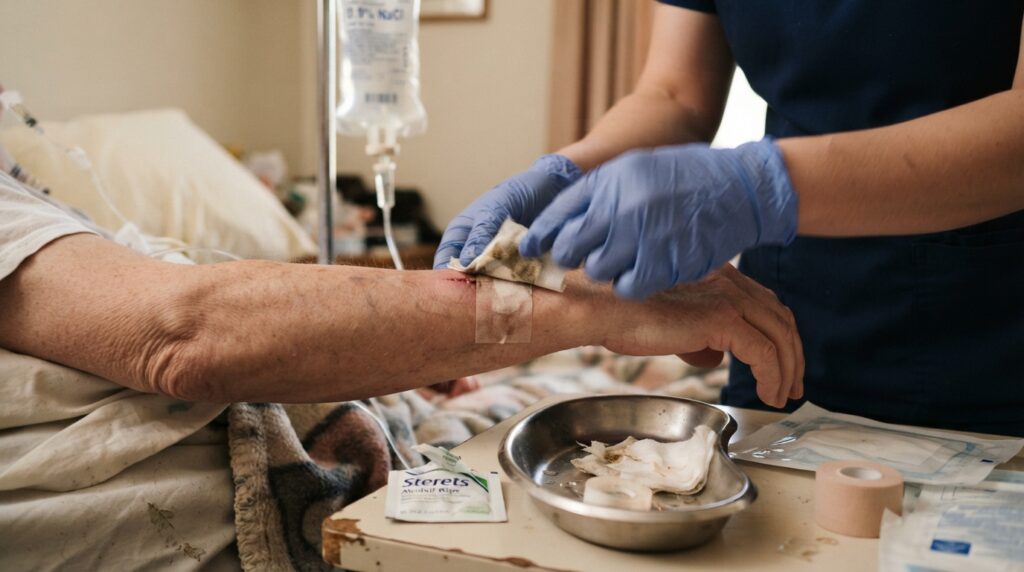
Every one of these tasks requires a licensed nurse’s clinical judgment, which is exactly why Medicare classifies them as “skilled” rather than personal care.
Not sure if your situation qualifies? Contact Choice Care Home Health at (708) 489 0123. Our nurses can review your discharge paperwork or physician’s orders and tell you plainly whether intermittent skilled nursing fits.
Who Qualifies for Home Health Care?
Medicare and most other payers use the same basic framework to determine who qualifies for home health care, including intermittent skilled nursing:
- A doctor must certify the need for skilled care. This occurs through a face-to-face visit, and the physician documents exactly what skilled services are required.
- The patient must be considered homebound: This doesn’t mean leaving the house; it means leaving requires considerable effort, assistance, or a device like a walker or wheelchair, and is generally limited to medical appointments or infrequent short trips.
- The care must be part-time or intermittent: Medicare’s home health benefit isn’t designed to fund full-time, 24-hour supervision.
- The care must come from a Medicare-certified agency: Not every home care provider bills Medicare. Verifying certification upfront avoids billing surprises later.
- The condition must be expected to improve, or the patient needs ongoing skilled monitoring to prevent decline.
Our FAQs page walks through additional details on homebound status and certification if you want the fuller picture.
What is the Difference Between a Home Health Aide and a Skilled Nurse?
This is the single most common point of confusion families run into, so it is worth laying out side by side.
| Skilled Nurse (RN/LPN) | Home Health Aide (HHA) | |
| Training | Licensed nurse (RN or LPN), state-licensed and clinically trained | Certified aide, trained in personal care, not licensed to perform medical procedures |
| What they do | Wound care, medications, IV therapy, monitoring vital signs, patient/caregiver education | Bathing, dressing, grooming, light housekeeping, meal prep |
| Who orders it | Physician ordered, part of a formal skilled plan of care | Typically added on top of skilled nursing or therapy, not billed as a stand-alone Medicare service |
| Can it stand alone under Medicare? | Yes, if skilled care is medically necessary | No Medicare generally requires an active skilled care need for aide services to be covered |
| Example task | Changing a wound dressing and checking for infection | Helping a patient get in and out of the shower safely |
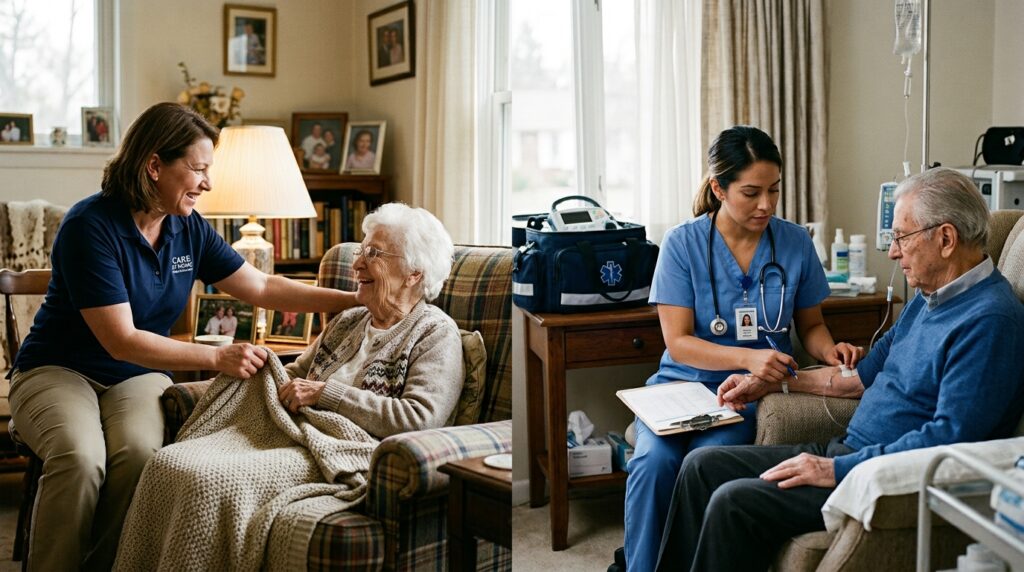
In short: a skilled nurse treats the medical condition. A home health aide supports daily living needs alongside treatment. Our Home Health Aides (HHAs) page covers exactly what aide-level support looks like once skilled care is already in place.
What Does a Home Health Nurse Do During a Visit?
A typical intermittent skilled nursing visit follows a consistent structure, even though the clinical tasks vary by diagnosis:
- Check vital signs and review symptoms: blood pressure, heart rate, oxygen levels, pain, and any changes since the last visit.
- Perform the ordered skilled task: a dressing change, medication administration, catheter care, or lab draw, depending on the plan of care.
- Assess for red flags, signs of infection, medication side effects, or decline that need to be reported to the physician.
- Educate the patient and family, showing a caregiver how to manage a task safely between visits, or explaining what symptoms warrant a call to the doctor.
- Document and communicate with the care team, updating the physician and coordinating with any therapists or aides also involved in the case.
Visits are typically 30 to 60 minutes, though this varies by the complexity of the care plan.
How Often Does a Skilled Nurse Visit Home?
The physician’s plan of care sets visit frequency and depends entirely on the medical need; no fixed schedule applies to every patient. A patient recovering from surgery with a healing wound might see a nurse two to three times a week initially, then taper to once a week as healing progresses. Someone newly diagnosed with heart failure might need more frequent visits first to fine-tune medications, then move to periodic monitoring. The frequency is reassessed regularly and adjusted as the patient’s condition changes.
How Long Does Home Health Care Last?
Home health care, including intermittent skilled nursing, is certified in 60-day episodes called certification periods. There is no fixed expiration date, but coverage is directly tied to medical necessity:
- If the skilled need continues and a doctor recertifies it, care can extend for an additional 60-day period.
- If the patient reaches their goals, the wound heals, the condition stabilizes, the skilled nursing need typically ends, since Medicare’s home health benefit isn’t intended for indefinite maintenance care.
- Most patients receive skilled nursing for a matter of weeks to a few months, though chronic or complex cases can continue longer with ongoing recertification.
Is Intermittent Skilled Nursing Covered by Insurance?
Yes, in most cases. Under Medicare.gov’s home health coverage rules, intermittent skilled nursing is covered under Medicare Part A and/or Part B when a doctor certifies the need, the patient is homebound, and care comes through a Medicare-certified agency like Choice Care Home Health. For approved services, Medicare typically pays 100% of the cost, though durable medical equipment tied to the care plan may carry a 20% coinsurance. Many Medicare Advantage plans and select private insurance plans also cover intermittent skilled nursing under similar terms. Our Insurance Plans page lists the specific plans we currently accept, including Humana and WellCare Medicare Advantage options.
Home health utilization has actually been declining nationally even as the need for it hasn’t gone away: according to MedPAC’s March 2021 Report to Congress, roughly 8.3% of all Medicare fee-for-service beneficiaries used home health care in 2020, with about 3 million beneficiaries receiving the benefit that year. That’s a meaningful share of Medicare patients relying on skilled nursing and therapy at home rather than in a facility.
How to Get a Home Health Care Referral
Getting a referral started is usually simpler than families expect once they know the sequence:
- Talk to the attending physician or hospital discharge planner. Most referrals start right after a hospital stay, surgery, or new diagnosis. This is the fastest path to getting care in place.
- Confirm the need for skilled care. The doctor documents the specific skilled service required (wound care, medication management, etc.) during a face-to-face visit.
- Choose a Medicare-certified home health agency. Ask directly whether the agency is Medicare certified and how quickly they can start after receiving the order.
- The agency verifies insurance and builds a plan of care. This includes confirming coverage details through your specific plan. Our Patient Info page explains what we handle on the verification side.
- Visits begin, typically within a few days of the physician’s order. The nursing team coordinates ongoing care with your doctor from there.
Ready to start the referral process? Send a referral to Choice Care Home Health or call (708) 489 0123. We coordinate directly with physicians and hospital discharge teams across Cook, DuPage, and Will counties to get care started quickly.
Signs You or a Loved One May Need Skilled Nursing Care
A few situations tend to point directly toward intermittent skilled nursing rather than personal care alone:
- A recent hospital discharge involving surgery, a new diagnosis, or a wound that needs professional dressing changes
- A chronic condition, such as diabetes, COPD, or heart failure, that needs regular monitoring to avoid a return trip to the ER
- A new medication regimen that’s complex or carries a risk of side effects
- A need for IV therapy, injections, or catheter care that a family member isn’t trained to safely manage
- Frequent falls, confusion, or noticeable decline that a primary care doctor hasn’t yet evaluated
If any of these sound familiar, it’s worth raising the question with your physician directly.
For Discharge Planners and Case Managers
If you’re coordinating a referral rather than researching care for your own family, the eligibility criteria above translate directly into your documentation: a physician’s certification of skilled need, homebound status, and a Medicare-certified receiving agency. Choice Care Home Health works directly with hospital discharge planners and case managers throughout Cook, DuPage, and Will counties to move referrals quickly, often starting visits within days of discharge. Review our Services overview for the full scope of what we coordinate: skilled nursing, physical therapy, occupational therapy, speech-language pathology, medical social work, and home health aide support under one plan of care.
Talk to a Nurse Before You Decide
Whether you’re trying to figure out if a parent qualifies for intermittent skilled nursing or you’re a case manager placing a referral, the fastest way to get a clear answer is to talk to a clinician who can review the specifics. Choice Care Home Health has been a Medicare-certified and ACHC-accredited home health agency serving the Chicago area since 2001. Call us at (708) 489 0123 or contact us online today, and we’ll help you figure out exactly what your situation calls for.
Faq Section
What is the difference between a home health aide and a skilled nurse?
A home health aide provides non-medical personal care, like bathing, dressing, and light housekeeping, while a skilled nurse (RN or LPN) delivers medical treatment such as wound care, medication management, and monitoring vital signs. An aide cannot perform clinical tasks, and Medicare generally requires an active skilled nursing or therapy need before it will cover aide visits.
What services does a home health aide provide?
A home health aide helps with activities of daily living, including bathing, grooming, dressing, light meal preparation, and light housekeeping tied to the patient’s care. Aides work alongside skilled nurses or therapists as part of a broader plan of care; they don’t perform medical procedures or manage medications independently.
How long does home health care last?
Home health care, including intermittent skilled nursing, typically lasts from a few weeks to a few months, depending on the medical need. Coverage is authorized in 60-day certification periods and can be extended if a physician recertifies that skilled care is still necessary; it generally ends once the patient’s condition stabilizes or improves.
How do I get a home health care referral?
To get a home health care referral, start by talking to the patient’s physician or hospital discharge planner, who will certify the need for skilled care after a face-to-face visit. From there, you choose a Medicare-certified agency, which verifies insurance and builds a plan of care, with visits typically starting within a few days.
What is skilled nursing care at home?
Skilled nursing care at home is medically necessary treatment, like wound care, IV medications, or chronic disease monitoring, delivered by a licensed nurse under a physician’s plan of care. It’s distinct from personal care because it requires clinical training and judgment, and it’s typically part-time or intermittent rather than continuous.
How often does a skilled nurse visit at home?
Visit frequency depends entirely on the physician’s plan of care and the patient’s medical needs, so there’s no single standard schedule. A patient recovering from surgery might see a nurse two to three times a week at first, tapering down as healing progresses, while a chronic condition may need ongoing periodic monitoring.
Is intermittent skilled nursing covered by insurance?
Yes, intermittent skilled nursing is typically covered by Medicare Part A/B, many Medicare Advantage plans, and select private insurance when a doctor certifies the need, the patient is homebound, and care comes from a Medicare-certified agency. Medicare usually pays 100% of approved visits, though equipment costs may carry a coinsurance.