

Coming home from the hospital can feel like a relief and a little overwhelming at the same time. After hospital discharge, care providers provide professional medical and supportive services in your home to help you recover safely, avoid complications, and reduce the risk of readmission. It typically includes skilled nursing visits, physical or occupational therapy, and assistance from a home health aide. In the Chicago area, Medicare-certified agencies like Choice Care Home Health can often begin services within 24–48 hours of discharge.
Key Takeaways
- Post-hospital home care bridges the gap between leaving the hospital and fully recovering at home.
- Core services include skilled nursing, physical therapy, occupational therapy, speech therapy, home health aide support, and medical social work.
- Medicare Part A and Part B typically cover home health when you meet eligibility requirements. There is usually no copay for Medicare-covered visits.
- Starting care quickly after discharge reduces the risk of complications and readmission.
- Choice Care Home Health serves Chicago, Cook County, DuPage County, and Will County. Call (708) 489-0123 to arrange care.
Why the First Days of Post-Hospital Care Matter Most
Hospitals are focused on stabilizing you. Once you’re medically ready to leave, the work of actual recovery, rebuilding strength, managing new medications, and watching for complications shifts to you and your family. That’s a big handoff.
Research from the Agency for Healthcare Research and Quality (AHRQ) found that nearly one in five Medicare patients is readmitted within 30 days of discharge. Many of those readmissions are preventable with the right support in place at home.
The most common reasons people struggle after a hospitalization include:
- Confusion about new medications or changed dosages
- Wound care needs that family members aren’t trained to handle
- Weakness and fall risk that wasn’t as obvious before surgery or illness
- No follow-up appointment scheduled, or difficulty getting to the doctor’s office
- Unmanaged pain, swelling, or early signs of infection
Professional home health care after hospitalization addresses all of these directly in your home, on your schedule
What Services Are Included in Post-Hospital Care at Home?
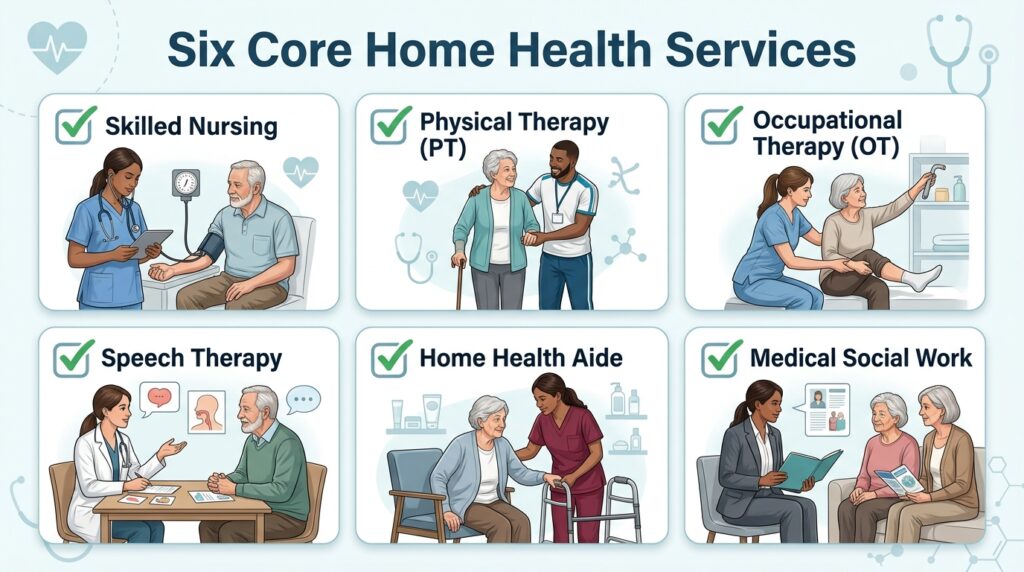
Home health after discharge isn’t one-size-fits-all. Your physician or hospital discharge planner authorizes a specific plan of care based on your diagnosis and needs. The most common services include:
| Service | What It Does | Who Provides It |
| Skilled nursing | Wound care, medication management, IV therapy, disease monitoring | Registered nurse (RN) or licensed practical nurse (LPN) |
Physical therapy (PT) | Rebuilds strength, mobility, and balance after surgery or illness | Licensed physical therapist |
| Occupational therapy (OT) | Helps you safely manage daily activities like bathing and dressing | Licensed occupational therapist |
| Speech therapy | Addresses swallowing, communication, or cognitive difficulties | Speech-language pathologist |
| Home health aide | Assistance with personal care, bathing, and grooming under a nurse’s supervision | Certified home health aide |
| Medical social work | Coordinates community resources, counseling, and discharge planning support | Licensed social worker |
You don’t necessarily need all six. Many patients need only skilled nursing and physical therapy. Others recovering from a stroke or hip fracture may use the full range.
Learn more about the intermittent skilled nursing services and physical therapy programs Choice Care Home Health provides throughout the Chicago area.
Does Medicare Pay for Home Health Care After the Hospital?
This is the question we hear most often from families, and the answer is almost always yes, as long as you meet a few key conditions.
Medicare Part A and Part B cover home health services when:
- Your physician certifies that you are homebound (leaving home requires considerable effort due to your condition)
- You need skilled care, meaning a service that must be provided by or under the supervision of a licensed professional
- The home health agency is Medicare-certified (Choice Care Home Health is)
- Care is medically necessary and ordered by your doctor
Medicaid and many private insurance plans also cover post-discharge home care. Our team can verify your coverage before your first visit. For a detailed breakdown, see our guide to insurance plans we accept and our article on Medicare home health coverage in Illinois.
How Quickly Can Home Care Start After Leaving the Hospital?
Speed matters. The first 24–72 hours after discharge are when medication errors, dehydration, and wound complications are most likely to surface. Here’s how the process typically works:
- Before you leave the hospital, your discharge planner or case manager identifies that you need home health and either contacts an agency directly or gives you a list of Medicare-certified options in your area.
- A physician’s order is written authorizing home health services. This is required for Medicare to cover the care.
- The home health agency receives the referral and contacts you or your family to schedule an initial nursing assessment.
- An RN visits your home often, the same day or the next, to complete the assessment, review your discharge instructions, reconcile medications, and establish your plan of care.
- Therapy and aide services begin, typically within one to three days, as scheduled by your care team.
At Choice Care Home Health, we routinely begin care within 24–48 hours of receiving a referral for patients in Chicago, Palos Hills, and surrounding Cook, DuPage, and Will County communities.

Who Coordinates Care After Discharge?
When you’re in the hospital, a discharge planner, usually a nurse or licensed social worker, is responsible for preparing your exit. They assess your home situation, connect you with community resources, schedule follow-up appointments, and refer you to home health if you qualify.
Once you’re home, responsibility shifts to the home health agency’s care team and, ultimately, your physician. Your nurse case manager at the agency becomes your primary clinical contact: tracking your progress, communicating changes to your doctor, and adjusting the care plan if your condition changes.
Family caregivers play an essential role, too. A good home health agency will always involve family in education and discharge planning, teaching wound care techniques, medication schedules, and what warning signs to watch for. You shouldn’t feel like an outsider in your own parents’ recovery.
Recovering from Surgery or a Specific Condition: What to Expect
Different diagnoses call for different approaches. Here’s a snapshot of what recovery often looks like:
After joint replacement (hip, knee), expect significant focus on physical therapy rebuilding range of motion, strength, and safe ambulation. A home health aide helps with bathing and dressing while mobility is limited. Our article on home care after surgery and physical limitations covers this in detail.
After a cardiac event (heart attack, heart failure, bypass surgery), skilled nursing visits focus on monitoring vital signs, managing fluid retention, educating on sodium intake and medication, and catching early warning signs of deterioration.
After a stroke, therapy is often multi-disciplinary: PT for mobility, OT for self-care, and speech therapy for swallowing or communication difficulties. Medical social work may connect the family with longer-term support resources.
After pneumonia or a respiratory illness, nursing visits monitor oxygenation, medication compliance, and signs of returning infection. Therapy may address deconditioning from bed rest.
Planning a Discharge? We Make It Easy for Care Teams.
If you’re a hospital discharge planner, case manager, or social worker in the Chicago area, Choice Care Home Health accepts same-day and next-day referrals. We’re Medicare-certified and ACHC-accredited, and we’ll keep you informed with timely clinical updates. Visit our services page or call our referral line at (708) 489-0123 to get started.
How to Prevent a Hospital Readmission After Discharge
Readmission is every family’s biggest fear and a realistic one. These evidence-based steps, combined with professional home health care, significantly reduce the risk:
- Get the complete discharge summary before leaving the hospital, including all diagnoses, medication changes, activity restrictions, and follow-up appointments.
- Fill all new prescriptions before you come home, or make sure a family member can pick them up the same day.
- Attend every follow-up appointment. The first visit with your physician after discharge is critical; your nurse can help you prepare for it.
- Know the warning signs specific to your condition. Your nurse will teach these at the first home visit.
- Don’t wait to call. If something seems wrong, contact your home health nurse or physician immediately. A phone call to your agency is faster and safer than waiting to see if a symptom resolves on its own.
Home health agencies are required under Medicare Conditions of Participation to have a nurse available by phone 24 hours a day, seven days a week. At Choice Care Home Health, that’s always been the standard, not just a requirement.
What Happens When Home Health Ends?
Home health care is designed to be temporary, goal-oriented care. Once you’ve met your goals, you can safely walk to the bathroom, manage your own wound dressing, and regulate your medications. The skilled care component ends. That’s a success, not an abandonment.
For some patients, particularly those with chronic conditions or ongoing mobility limitations, a home health aide for personal care may continue under a different program after skilled care concludes. Your care team and social worker can help you understand what long-term options exist.
If your needs are more extensive than can be safely managed at home, your care team will have an honest conversation about whether a skilled nursing facility or another care setting is the right next step.
Ready to Set Up Care? Here’s How to Reach Us
Whether you’re being discharged this week or you’re a family member trying to plan, we’re here to help you figure out the right level of care and whether your insurance will cover it.
Choice Care Home Health is Medicare-certified and ACHC-accredited, serving patients across Chicago, Palos Hills, Palos Heights, and Cook, DuPage, and Will counties in Illinois.
- 📞 Call us at (708) 489-0123. We answer referral calls 7 days a week
- Explore our full range of home health services
- Learn about insurance and coverage options
- Contact us online to have a care coordinator reach out to you
You don’t have to navigate post-discharge recovery alone. Let us come to you.
FAQ Section
Q1: What is post-hospitalization care?
Post-hospitalization care is professional medical and supportive care provided in your home after a hospital stay, including skilled nursing, physical and occupational therapy, and home health aide support. Ordered by your physician, it helps you recover safely, manage new medications and wounds, rebuild strength, and avoid readmission. Medicare covers it through certified agencies like Choice Care Home Health, which serves Chicago and Cook, DuPage, and Will counties, often starting within 24–48 hours of discharge.
Q2: How soon can a home health agency start after I leave the hospital?
Most Medicare-certified agencies, including Choice Care Home Health, can begin care within 24–48 hours of receiving a referral and a physician’s order. The faster care starts, the better, as the highest-risk period for complications and medication errors is in the first 48–72 hours after discharge. Ask your hospital discharge planner to make the referral before you leave.
Q3: Does Medicare cover home health care after hospitalization?
Yes. Medicare Part A and Part B cover home health care when you are homebound, your physician certifies a need for skilled care, and you use a Medicare-certified agency. There is generally no copay for covered home health visits. A prior hospital stay is not always required, and there’s no minimum number of inpatient nights needed. See our full guide to Medicare home health coverage in Illinois.
Q4: What is the difference between home health care and home care?
Home health care (also called skilled home health) is medical care provided by licensed professionals, such as nurses, physical therapists, and occupational therapists, and ordered by a physician, and is typically covered by Medicare or insurance. Home care (sometimes called private-duty or custodial care) refers to non-medical support, such as companionship, housekeeping, and personal care, that is usually not covered by Medicare.
Q5: Who decides what home health services I get after discharge?
Your physician authorizes home health and writes the orders for specific services. The hospital discharge planner or case manager typically facilitates the referral and helps identify an appropriate agency. Once care begins, the home health agency’s nurse completes a full assessment and, in coordination with your physician, develops a detailed plan of care tailored to your condition, goals, and home environment.
Q6: What should I ask the discharge planner before leaving the hospital?
Ask: (1) Which home health agency is being arranged? Is it Medicare-certified? (2) When will the first home visit occur? (3) What warning signs should I watch for at home, and who do I call? (4) Are all my prescriptions called in and ready to pick up? (5) When is my first follow-up appointment with my doctor, and how will I get there? Getting clear answers to these questions before leaving significantly reduces post-discharge complications.
Q7: Can I choose my own home health agency after a hospital discharge?
Yes. Under Medicare, you have the right to choose any Medicare-certified home health agency that serves your area. The hospital may recommend an agency, but the choice is yours. If you are in Chicago, Cook County, DuPage County, or Will County, Illinois, you can request Choice Care Home Health directly by calling (708) 489-0123. Your discharge planner can process the referral to your agency of choice.