
Introduction
When someone you love comes home after a stroke or a brain injury, it can feel like everything has changed. The way they talk. The way they find words. Even simple conversation can feel like hard work now.
I have worked with families in this exact situation many times. And one of the first things they ask me is: Can we do anything at home? Or do we just wait for the next therapy appointment?
The honest answer? Yes. You absolutely can do meaningful work at home. It takes patience. It takes consistency. But it can make a real difference in how fast someone recovers.
This guide is for families and adult patients who want practical, simple steps. No confusing medical language. No unrealistic promises. Just real guidance from someone who has seen what actually helps.
And if you are also looking for in home speech therapy for seniors near you, know that speech therapy and physical therapy often go hand in hand during recovery. We will touch on that too.
Can Speech Therapy Really Be Done at Home?
Yes. But let me be straightforward with you about what that means.
Home practice is not a replacement for professional care. A trained speech therapist can assess what is actually happening in the brain and the mouth. They can catch things a family member might miss. That expertise matters.
But here is what I tell every family I work with: therapy does not stop when the session ends. The brain needs repetition to rebuild pathways. And that repetition happens at home.
The families who see the best outcomes are the ones doing daily exercises between visits. Not perfectly. Not for hours. But consistently.
Even 15 to 20 minutes a day adds up to something meaningful over weeks and months.
When Is Home Therapy Appropriate?
Home speech therapy works best for adults who:
- Are in a stable recovery phase after stroke or injury
- Have mild to moderate speech or communication challenges
- Are already working with a professional therapist and want to practice in between sessions
- Need support maintaining skills over the long term
Sometimes a person does not need daily professional visits. They may be receiving what is called intermittent skilled nursing care, where a professional checks in periodically while most of the daily support happens at home. In those cases, having a solid home routine is especially important.
If someone is in the early, acute phase of recovery, or if their speech issues are severe, that is a different situation. They need more intensive professional support first.
Setting Up for Speech Therapy at Home
One thing I always emphasize: at home, things do not have to be perfect. You do not need a clinic setup. You need a few simple things.
A quiet space
Background noise makes speech work much harder. Turn off the TV. Find a calm corner. Even a bedroom works fine.
A consistent time of day
The brain responds better when there is a routine. Morning after breakfast. Early afternoon. Whatever works for the person. Just keep it regular.
Family involvement
You do not need a therapist in the room for every session. A family member who listens patiently and encourages without correcting harshly can be incredibly valuable. The emotional safety matters just as much as the exercise itself.
Simple tools
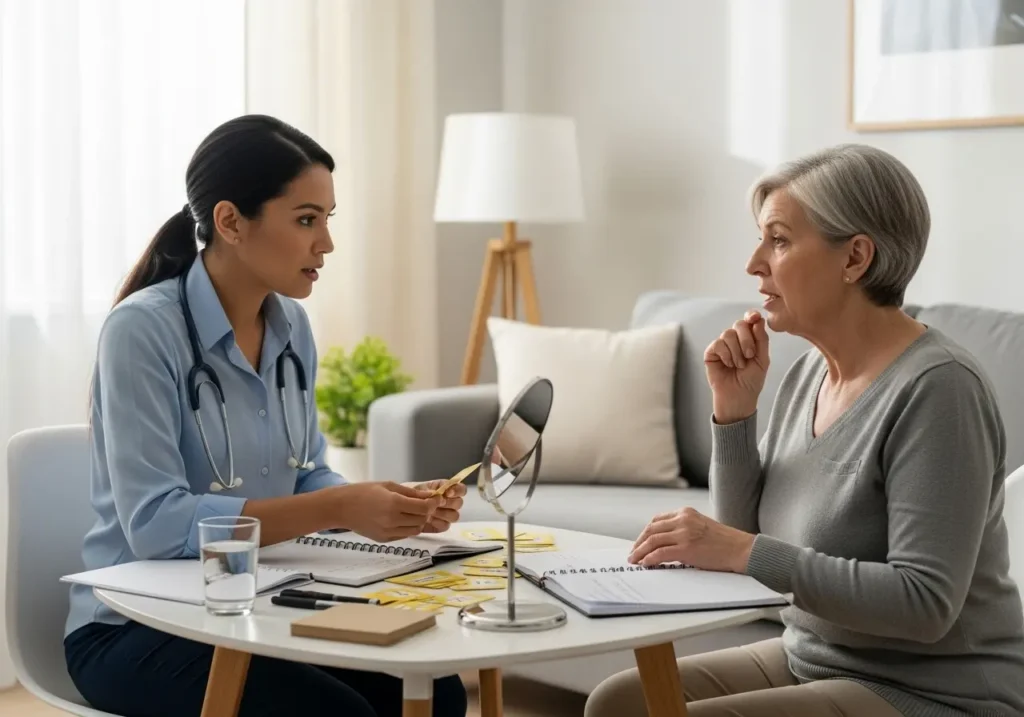
A notebook. Printed word lists. Picture cards (great for naming practice). A mirror for mouth exercises. That is honestly all you need to start.
Simple Speech Therapy Exercises for Adults
These are exercises I use regularly. They work. They are simple enough to do without a therapist present.
Word Repetition
Start with short, familiar words. Say a word slowly and clearly. Then have the person repeat it. Do not rush. If they say it wrong, model it again gently. Focus on common words first: names of family members, household objects, simple verbs like eat, walk, sit.
Reading Aloud
Pick something simple. A short paragraph from a newspaper. A children’s book. Even a grocery list. Read it aloud together, slowly. This builds both word retrieval and the physical muscle memory of forming sounds.
Naming Objects
Hold up an everyday object, or point to something in the room. Ask the person to name it. A cup. A window. A shoe. If they struggle, give a hint. The first sound. Or a sentence with a blank: You drink from a. This is one of the most practical speech therapy exercises at home because it fits naturally into daily life.
Conversation Practice
Just talk. Ask simple open questions. What did you have for breakfast? What is something you enjoyed doing years ago? Let the person answer in their own time. Do not finish their sentences for them. That patience, it is hard sometimes, but it gives the brain space to work.
Breathing and Voice Exercises
Take a slow, deep breath in through the nose. Hold for two seconds. Then breathe out while humming or saying a long aaah. This warms up the voice and improves breath support for speaking. Do this 5 to 10 times before other exercises. Home care physical therapy and speech therapy both recognize how much breath control affects overall recovery.
Cognitive and Communication Practice
Speech is not just about the mouth. It is connected to memory, thinking, and processing. So some exercises focus on the mind as much as the voice.
- Memory exercises: Name five things in a category. Animals. Foods. Cities. Colors. It sounds simple. But it builds word finding speed and memory recall.
- Sentence building: Give a person a topic and ask them to make a sentence. The dog or Yesterday I Short sentences first. Then longer ones when ready. This bridges the gap between finding words and putting them together.
- Listening exercises: Read a short paragraph and then ask one or two simple questions about it. This trains auditory processing. Understanding language is just as important as producing it.
The Role of Physical and Home Health Support
Something families often do not expect: speech recovery does not happen in isolation. The whole body is involved in healing.
Fatigue affects speech. Pain affects concentration. Posture affects breathing, which affects voice. So when someone is also receiving home health care and physical therapy, it actually supports speech outcomes too.
Families sometimes search for in home physical therapy services near me without realizing that a coordinated care team, where physical and speech therapy happen together at home, often produces better results than either alone.
Physical therapy home health care programs often include conditioning, balance, and mobility work that keeps the person active and mentally engaged. That engagement feeds directly into communication recovery.
Support from Professionals: Who Does What?
It helps to understand who is on your care team and what each person does.
A speech language pathologist (SLP)
This is the professional who evaluates and designs the full speech therapy program. They identify what type of communication disorder is present and set the goals.
A physical therapy assistant in home health care
Works under a supervising physical therapist to carry out mobility and strength exercises in the home. They are often the people you see most often during a recovery period.
Skilled nurses
If you are in an area like Palos Hills, IL, skilled nursing care at home means a registered nurse visits periodically to monitor health, manage medications, and coordinate with the rest of the team. They catch complications early and keep recovery on track.
Finding Local Care Support in Illinois
For families in the Chicago suburbs and surrounding areas, it is worth knowing that coordinated home care services are available across many communities.
Whether you are looking for in home health care in Orland Park IL, senior home care in Palos Heights, IL, physical therapy services in Oak Lawn, IL, or older health care services in Naperville IL, the options for receiving professional speech and physical therapy at home have expanded significantly.
Home based care is not second rate care. In many cases, it leads to better outcomes because the person is recovering in their own familiar environment, surrounded by the people they know and love.
Common Mistakes to Avoid
I see the same mistakes come up again and again. They are understandable. But they slow things down.
- Doing too much too fast: The brain after injury tires quickly. A 20 minute focused session beats a 90 minute exhausting one every time. Keep it short and regular.
- Correcting too harshly: It is hard to hear someone you love struggle with words. But constant correction creates anxiety. And anxiety makes speech worse. Model the word gently. Move on. Celebrate effort.
- Skipping days because nothing is happening: Progress in speech recovery is often invisible for a while. Then suddenly there is a leap. Inconsistency breaks the momentum. Even on hard days, a few minutes of easy practice is worth more than skipping entirely.
- No professional guidance at all: Home practice works best when a professional has assessed the person and given direction. Without that, you might be practicing the wrong things. An evaluation from a speech therapist or in home physical therapy for seniors near you can shape the whole approach.
When to Seek Professional Help
Home practice is powerful. But there are clear signs that it is time to get professional eyes on the situation.
- Speech is getting worse, not staying the same or improving
- The person is having difficulty swallowing (this can be a medical issue requiring prompt evaluation)
- There is no progress after 4 to 6 weeks of consistent daily practice
- The person becomes withdrawn, frustrated, or refuses to practice
- New symptoms appear such as facial drooping or sudden worsening
If any of these happen, do not wait. Reach out to a speech therapist or search for home health care physical therapy near me to find a team that can assess the full picture. In home physical therapy for seniors is widely available and can be started quickly in most areas.
Common Questions Families Ask
How long does speech therapy take?
There is no single answer. Mild aphasia after a stroke might improve significantly in a few months. More complex conditions may take a year or longer. What matters most is consistency, not speed.
Can recovery be full?
Sometimes, yes. The brain has remarkable plasticity, especially in the first two years after injury. Many people regain significant communication ability. Full recovery is possible for some. For others, the goal becomes adapting and communicating effectively in new ways.
How often should exercises be done?
Daily is ideal. Even 15 to 20 minutes, done every day, produces better results than longer sessions two or three times a week. Short. Consistent. Regular.
Is professional help necessary?
For most adults recovering from stroke or brain injury, yes. A professional assessment at minimum is very important. It shapes everything you do at home. You can still do the daily practice yourself, but having a professional guide the plan makes that practice much more effective.
What if the person gets angry or refuses to practice?
This is very common. Frustration is part of the experience. Take breaks without guilt. Try a different activity. Sometimes just sitting together and having a natural conversation counts as practice. Do not force it. Come back gently tomorrow.
Does age affect recovery?
Older adults can and do make meaningful progress. Recovery may be a bit slower, and goals may look different. But the brain remains capable of change at any age. Do not let age become a reason to stop trying.
Small Steps. Real Progress.
This is something I want every family to hear before they close this page.
Progress in speech recovery is often quiet. It does not always announce itself. But one day, the person says a word faster than before. Or they hold a conversation a little longer. Or they laugh at something and the words come out easy, the way they used to.
Those moments are built by the daily 20 minute sessions. The patience when a word does not come. The encouragement that keeps a person going when they feel like giving up.
You do not have to have all the answers. You do not have to be a therapist.
You just have to show up. Consistently. With kindness. That is what makes home therapy work. Read more